A burst pipe repair Tulsa call is the highest-emotion plumbing emergency we run. Water is actively spreading, drywall is staining, hardwood is cupping, and the homeowner is racing the damage clock with one hand on a shutoff valve they may have never used before. This page covers how our Tulsa network responds — from the first 60 seconds of stabilisation through code-compliant permanent repair, across every pipe material and failure mode common to Oklahoma homes.
The core failure modes we see: freeze rupture (ice expansion splitting the pipe longitudinally), pinhole pressure burst (electrolytic corrosion in copper), failed solder joint (capillary action failure or wrong solder), failed PEX fitting (crimp ring or expansion fitting), galvanized blowout (internal corrosion eating through), polybutylene degradation (1978-1995 era resin failure), and water-hammer pressure spike (PRV failure or closed-system thermal expansion). Each presents differently. Each has its own repair scope. Our dispatch coaches you through diagnosis on the phone while the truck is rolling.
When You Smell Trouble — Spotting a Ruptured Line Before Damage Spreads
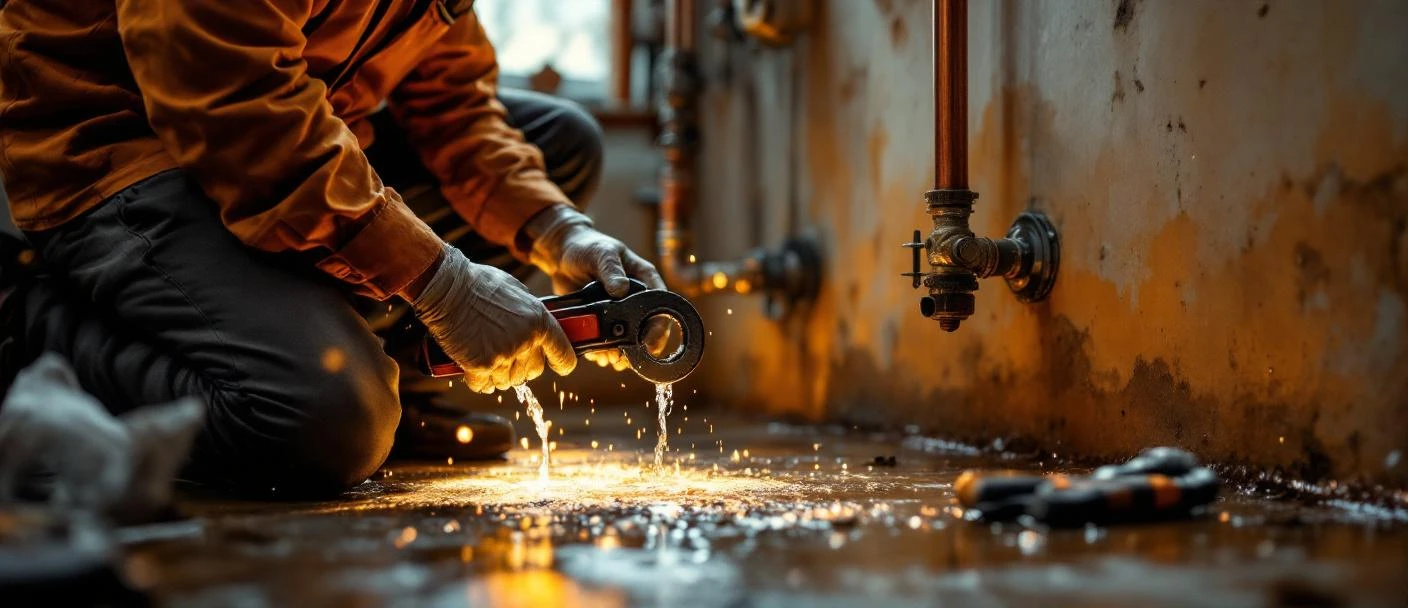
Most Tulsa burst pipes announce themselves with sound first — a hiss, a rush, or the distinctive chatter of water under pressure escaping a freshly opened split. Visual confirmation comes seconds later as drywall darkens, a ceiling stain appears, or water sheets across a basement floor. The earliest warning signs are usually pressure-side: a fixture that runs hot only briefly, a faucet that loses pressure mid-shower, or a water meter that spins with all fixtures off.
Pre-burst symptoms in copper systems typically run for weeks before the actual rupture. Pinhole leaks weep slowly into wall cavities, mineral deposits build at the leak point, and a trained ear can hear the high-pitched seep with a stethoscope. Galvanized supply lines usually telegraph end-of-life through pressure complaints first — bore-narrowing scale chokes flow before any pipe fails outright. Polybutylene gives almost no warning; it tends to fail catastrophically at a fitting joint with no preliminary leak.
The most reliable early warning is your monthly water bill. A bill that climbs even 15-25% with no change in household usage usually means an active leak somewhere. City of Tulsa Water billing departments will usually flag unusual usage when asked, and we can run a meter-isolation test on dispatch to confirm the leak before the burst becomes catastrophic.
What Causes a Pipe to Rupture in Tulsa Homes
The single most defining freeze event in Tulsa memory is winter storm Uri in February 2021. Across multiple consecutive days at 16°F, attic and crawlspace pipe runs that had survived ordinary Tulsa winters for decades split open. Hose-bibs back-fed into wall cavities. Water heaters in unheated garages froze on the cold side. The lessons our network took from Uri shape every freeze response we run today: insulation alone isn’t enough for Uri-class events, heat trace matters in vented attics, and frost-free sillcocks need at least 6 inches of stem length to actually protect the back of the valve.
Beyond freeze, Tulsa’s moderately soft 60-90 mg/L water from the Lake Spavinaw / Lake Eucha watershed is mildly aggressive to copper. Type M copper installed across Brookside (74105) and Florence Park (74105) during 1940s-60s post-war construction is now in active pinhole-failure window. The 60-80 psi standard service pressure compounds the issue — by the time a pinhole develops to weep visible water, the pipe wall has thinned far enough that pressure spikes can produce a full longitudinal split.
Galvanized supply lines from pre-1930 Maple Ridge (74114), Cherry Street (74104), and Owen Park (74127) mansions face a different failure mechanism: internal mineral occlusion narrows the bore by 30-50% over 50-70 years. The narrower the bore, the higher the local pressure differential, and the closer the pipe gets to its yield point. A municipal main flush or PRV failure is often the trigger that produces the actual burst.
How Our Plumbers Stop the Water and Restore the Line
The first move on every burst call is shutoff verification. Our dispatch coaches you to your main shutoff valve while the truck rolls — clockwise to close, never overtighten on a stuck gate valve. Pre-1960 homes commonly have legacy gate valves that have seized closed-position over decades; if you can’t get the main to turn, the curb-stop at the property line becomes the next option, and City of Tulsa Water has the curb-stop key on their emergency line.
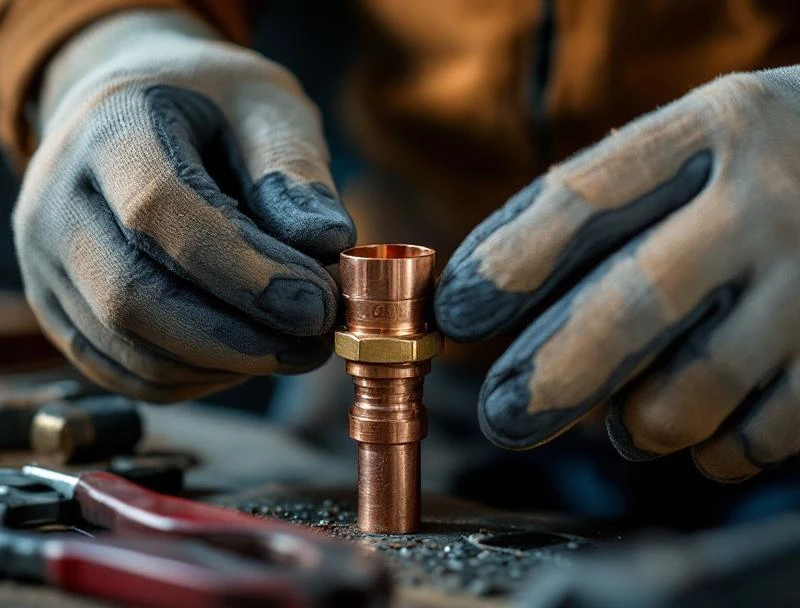
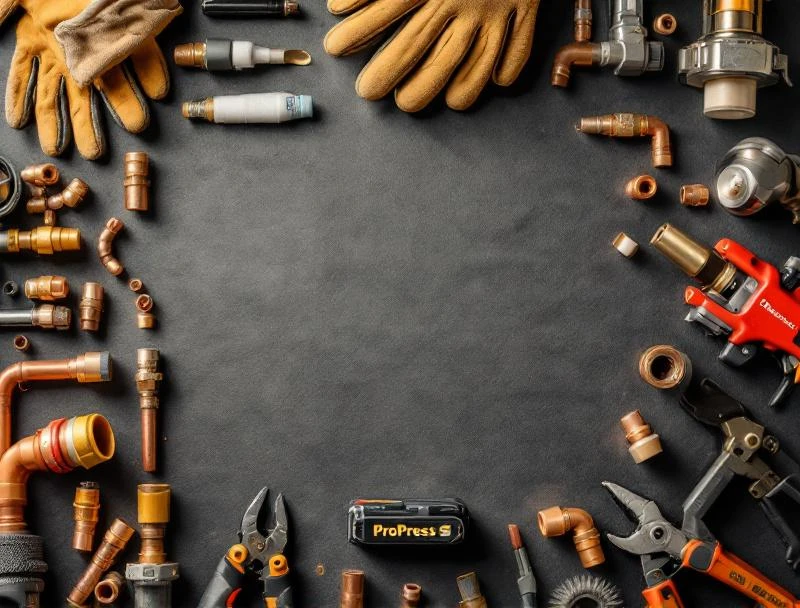
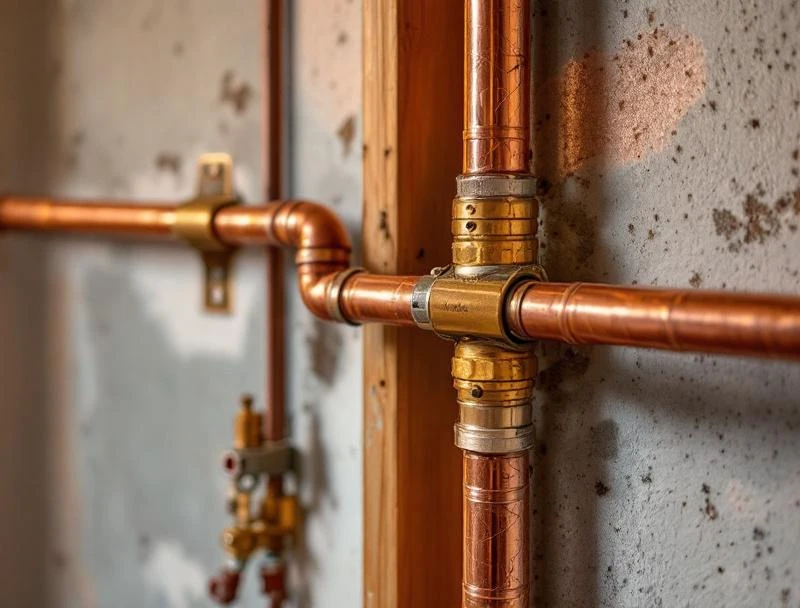
Once the truck arrives, the plumber drains the line by opening the lowest fixture in the affected zone. The damaged section gets cut out with a tubing cutter (copper) or ratcheting cutter (PEX). The cut is deburred and cleaned. Repair couplings then go in: ProPress for copper (Viega ProPress jaws on a Milwaukee M18 Force Logic press tool), expansion fittings for PEX-A (Uponor ProPEX system), or crimp rings for PEX-B (Milwaukee M12 PEX crimp tool with calibrated jaws).
Pressure testing follows immediately. We charge the line to 50 psi air or 80 psi water for at least 15 minutes and watch the gauge. Any drop signals a remaining leak. Restoration of service is gradual — slowly opening the main and watching for joint weep before declaring the repair complete. We document the repair material and failure mode for insurance, photograph the finished work, and coordinate any drywall or finish coordination separately.
A burst T&P relief discharge often points to a failed temperature-and-pressure valve or thermostat runaway, and Tulsa water heater repair scope covers diagnosis and component replacement before the unit floods the closet again.
Pipe Materials Found in Tulsa Homes and How They Fail
Tulsa’s housing stock spans nearly a century of plumbing material choices. Type M and Type L copper dominate mid-century construction; Type M is now in active pinhole-failure window across Brookside (74105) and Highland Park (74112). Type K copper is the heavy-wall service material occasionally seen as the supply main into the home. Galvanized iron was standard pre-1960 — actively failing across Cherry Street (74104), Maple Ridge (74114), and Owen Park (74127).
Polybutylene (PB) was widely installed across Oklahoma 1978-1995 before the class-action settlement. Affected Tulsa neighborhoods of that era should expect random-timing burst events at fittings; the resin embrittles under chlorinated water exposure and the failure clock is now well past its end. Identify polybutylene by its gray colour and acetal-plastic crimped fittings.
PEX-A (Uponor / Wirsbo) uses expansion fittings with stainless steel rings; failure mode is occasional fitting failure from the 2010-2015 boom in Broken Arrow (74012) and Owasso (74055). PEX-B (SharkBite, Viega PureFlow) uses crimp rings or cinch clamps; failure mode is crimp-ring loosening under thermal cycling. CPVC is less common but present in Tulsa apartments — failure mode is brittle fracture from impact or solvent-weld joint failure.
Pre-2005 brass PEX fittings (specifically the Zurn / NiBrass and certain Watts lines) were subject to dezincification recall — homes built in that window face latent failure risk in 74133 South Tulsa and 74008 Bixby.
Why Tulsa Freezes Behave Differently Than Northern Cities
Tulsa’s frost line is set at roughly 12 inches per local code — far shallower than northern markets requiring 36-48 inches. This works for the typical 8-12 freeze days per year, but events like Uri drive ground freeze deeper than code minimum, exposing shallow service-line installs and outdoor-wall fixture runs. The Tulsa freeze pattern also tends toward short sharp ice storms rather than sustained deep freeze — pipes survive single-day events that buildings in true northern climates would never endure.
The key differentiator is exposure pattern. Most Tulsa burst losses come from attic and vented-soffit pipe runs rather than buried lines. The combination of a vented attic (R-19 or R-30 ceiling insulation but no wall-cavity protection above the ceiling plane) and an isolated supply run creates a freeze trap. Hose-bib bursts back-feed into wall cavities — a fast freeze pulls water from inside the wall toward the exterior fixture, and when the bib body splits, the leak occurs inside the wall on the warm side.
Yard-side bursts at shallow service-line depth trace back to service line freeze damage from the 2021 Uri event, and the repair scope often expands into trenchless replacement of the full meter-to-house run.
Oklahoma Plumbing Code Requirements for Replacement Work
Oklahoma uses the Uniform Plumbing Code (UPC, 2018 edition with state amendments) — not the International Plumbing Code that neighboring Arkansas and Texas adopted. That affects vent sizing, trap arm length, and approved materials. For burst pipe repair scope, the relevant requirements include hose-bib backflow prevention via vacuum breaker on every replacement, dielectric isolation when joining dissimilar metals, code-compliant pipe support spacing, and proper sleeving at slab penetrations.
Plumbing licensing is handled statewide by the Oklahoma Construction Industries Board (CIB) with verification at cib.ok.gov. Tulsa Codes & Construction Services handles permits inside city limits; surrounding suburbs each have their own permitting authority. Repipe scope (whole-home or significant zone replacement) typically triggers permit and inspection requirements; spot repair on accessible exposed pipe usually doesn’t.
When You Can Try a Patch Yourself and When to Call
A SharkBite push-fit fitting and a hacksaw will get most accessible burst-pipe situations stabilized for a homeowner with basic hand-tool skills. The risks: incorrect cut depth, failure to deburr, insufficient pipe insertion into the fitting, or attempting the patch on a pipe still under pressure. Behind-drywall, slab-internal, and vented-attic bursts are not appropriate DIY scopes — access alone often costs more than the actual repair.
If you have a SharkBite kit and the burst is on accessible exposed copper or PEX, you can often get water back on long enough to wait for a daytime repair. We would still come back to install a permanent ProPress or expansion-fitting joint — push-fit is a stopgap, not a permanent solution behind finished surfaces. For galvanized, polybutylene, or any pipe inside a wall or under a slab, call us first and let our plumbers handle access and repair as a single coordinated visit.
Slow-developing wall stains after a freeze event usually mean a partial split that’s leaking but not catastrophically, and Tulsa leak detection picks up the moisture and acoustic signature before the wall comes apart.
The First Two Minutes After a Pipe Bursts
Stop the water. Find the main shutoff (basement utility wall, garage, or near the meter pit) and turn it clockwise until it stops. If the main won’t move, the curb-stop at the property line is the backup; City of Tulsa Water has a 24/7 emergency line that can dispatch utility staff to operate the curb stop if you don’t have a key.
Open the lowest fixture in the affected zone to drain the line and reduce the pressure on the burst point. Cut power to any electrical circuit in the path of the water — wet outlets and submerged electronics are a fire and shock hazard. Move valuables and electronics out of the water path. Photograph everything for insurance. Call our dispatch and stay on the line — we coach stabilisation while a truck rolls.
Frozen Pipe Thawing — The Controlled-Heat Protocol
Frozen-pipe thaw must be controlled — never open flame. Hair dryer, heat lamp, or low-temp heat trace at the freeze point with shutoff partly open allows steam to escape rather than build pressure behind the ice plug. Open-flame thawing has caused fires across the metro and is the single leading cause of post-freeze burst-during-thaw events.
Identify the frozen segment by feeling along the pipe — the ice plug is colder than the surrounding line and may show frost on the exterior. Start heat application at the section closest to a faucet and work backward toward the freeze point. Keep the faucet partly open so escaping water signals the thaw progressing. EasyHeat and Frost King produce reliable heat trace cable; the RIDGID KJ-1750 pipe thawing machine is the professional tool for inaccessible thaws. Once thawed, insulate the segment with R-3+ tubular foam to prevent recurrence.
Pipe Insulation Upgrades for Tulsa Attics and Crawlspaces
Standard residential pipe insulation in Tulsa pre-Uri was tubular foam at R-2 or R-3 — adequate for 20°F overnight lows but inadequate for sustained 16°F multi-day events. Post-Uri standard practice is R-3+ tubular foam with heat trace cable on any pipe in unheated space. Armaflex tubular insulation and Frost King fiberglass pipe wrap are the materials we install most often.
For attic runs, the protection stack is heat trace cable wrapped along the pipe, R-3+ tubular foam over the cable, and additional R-19 batt insulation laid on top of the foam at the run location. Crawlspace runs get the same treatment plus crawlspace ventilation control — temporary baffles during freeze events to keep below-floor temperature above 32°F. Vented attics in South Tulsa (74133) and 74137 Southern Hills are particular candidates because the attic floor insulation works for the living space below but does nothing for the supply runs above the ceiling.
Hose-Bib (Sillcock) Freeze Proofing
Hose-bib freeze damage is one of the most common Tulsa burst-pipe scenarios because the failure happens inside the wall cavity rather than at the exterior fixture. A non-frost-free hose bib has the valve seat in the brass body itself, which sits at the exterior wall. When water freezes inside the bib body, the body cracks longitudinally and the next thaw pushes water back into the wall cavity — flooding drywall and insulation before any exterior leak shows.
Frost-free sillcocks (Woodford Model 17, Woodford Model 19, Prier C-244, Mansfield 500 series) move the valve seat 6-12 inches inside the wall, behind the warm side of the insulation. The exterior stem is just a connecting rod. When the homeowner closes the valve and disconnects the hose, water drains from the exterior stem out through the spout, leaving no water in the freezing zone. Code requires an anti-siphon vacuum breaker on every hose-bib replacement to prevent backflow contamination.
Attic and Crawlspace Pipe Protection
Attic supply runs are the highest-risk freeze location in Tulsa homes. Code permits supply runs through unconditioned attic space, and many builders chose this routing for cost — a single trunk line with branches dropping to fixtures avoids the wall-cavity rough-in cost. The price comes in freeze events: vented attics drop to outside ambient temperature within hours of a sustained freeze.
Protection options for attic runs include encapsulation in heated chase, relocation to interior wall cavities, heat trace + R-3+ insulation with attic-floor batt overlay, or full retrofit to a manifold home-run system that minimizes attic exposure. For crawlspaces, the protection stack is heat trace, tubular foam, and seasonal vent closure during freeze events. Pier-and-beam Maple Ridge (74114) mansions often have crawlspace supply runs that survive ordinary Tulsa winters but failed during Uri — those are ongoing retrofit candidates.
PEX Retrofit From Copper or Galvanized
After repeated burst events, full retrofit to PEX is often more economical than continued spot repair. The decision threshold: two or more pinhole leaks on copper within a 24-month window, or any single galvanized burst in a pre-1960 home. PEX retrofit through attic or wall cavities avoids slab work entirely — the old line is abandoned in place, drained, and capped.
PEX-A (Uponor / Wirsbo) uses expansion fittings: the pipe is expanded with a tool, the fitting inserted, and the pipe shrinks back to grip the fitting. PEX-B (SharkBite, Viega PureFlow) uses crimp rings — a crimp tool clamps the ring around the fitting hub. PEX-A is preferred for retrofit work because the expansion fitting flexes with thermal cycling; PEX-B crimp rings can loosen under heavy cycle counts. Either system installs faster than copper repipe and at roughly half the material cost.
Pipe Sleeve and Foam Insulation Installation
Tubular foam pipe insulation is the most cost-effective freeze prevention in Tulsa. Armacell tubular foam and IPS rigid foam pipe sleeves install with slit-and-snap technique — a 6-foot length costs $4-8, and a typical home might use 30-50 lengths to cover all exposed runs. The R-2 to R-3 thermal value isn’t enough for Uri-class events on its own, but combined with seasonal heat trace it’s the standard freeze prevention package.
Installation sequence: cut the foam to length, slit it lengthwise (most pre-slit), snap it around the pipe, and seal the seam with tape every 18-24 inches. Joint and elbow sections require corner pieces or careful mitring. Don’t compress the foam — its R-value depends on air-cell integrity, and crushed foam is little better than no foam at all.
Freeze-Resistant Outdoor Faucet Installation
Frost-free outdoor faucet installation is a common bundled service after burst-pipe repair. The Woodford Model 17 (residential standard) and Model 19 (heavier-duty commercial) both come in 6-inch, 8-inch, 10-inch, and 12-inch stem lengths — choose the length to position the valve seat at least 6 inches inside the warm-side wall cavity. The Prier C-244 is a similar option with a slightly different anti-siphon configuration.
Installation requires opening the wall to install the new sillcock body, sweating or PEX-connecting to the supply line, and properly slope the body downward toward the spout so it drains automatically when closed. The exterior trim screws to the siding with proper through-wall sealant. A vacuum breaker is required by code on every replacement and is integrated into most modern frost-free designs.
Emergency Water Shutoff Valve Replacement
Burst response calls almost always reveal a seized old shutoff valve at the main. Pre-1960 Tulsa homes commonly have legacy gate valves that have not been operated in decades — internal corrosion locks the gate in position, and forcing them often produces a stripped stem rather than valve operation. Once we have the homeowner’s water restored, replacing the seized main shutoff with a quarter-turn ball valve is standard follow-up work.
Apollo 70-100 series ball valves and Watts FBV ball valves are the residential standards. Replacement requires shutting off at the curb stop (or coordinating with City of Tulsa Water if the curb stop is inaccessible), draining the supply line, cutting out the old valve, and installing the new ball valve with appropriate adapters — usually copper sweat or PEX expansion fittings depending on the existing pipe material. Total time for a typical residential replacement is 1.5-2 hours.
Pinhole Pressure-Burst Repair
Pinhole burst differs from freeze burst in failure mode and repair scope. Freeze burst splits the pipe longitudinally for several inches, requiring section replacement. Pinhole burst is a localized perforation, often one to three small holes within a few inches, where electrolytic corrosion has thinned the pipe wall to the point that water pressure exceeds yield strength. The pipe is structurally intact except for the pinholes themselves.
Spot repair for a single pinhole uses a soldered coupling spanning the perforated section. Type M vs Type L copper matters — Type M is thinner-walled and more susceptible to electrolytic corrosion, especially in Tulsa’s mildly aggressive moderately soft water. If we find one pinhole on Type M, statistical analysis suggests several more are forming — many homeowners elect for full PEX retrofit of the affected zone after the initial spot repair confirms the failure mode.
When the burst signature traces below grade in 74133 South Tulsa or 74137 Southern Hills, the failure mode shifts toward slab leak in 74133 territory and the locate-then-cut scope changes accordingly.
Soldered Joint Failure Repair
Failed solder joints leak slowly and typically don’t burst catastrophically. The failure mode is capillary action breakdown — solder didn’t fully draw into the joint during original installation, or flux contamination left a void path. Visible signs include green corrosion staining at the joint and slow weep when the line is pressurized.
Repair requires draining the line, removing the failed joint with a tubing cutter, and either soldering a new joint or pressing a ProPress fitting. 95/5 lead-free solder with appropriate flux is the residential standard since the 1986 federal ban on lead solder for potable water. MAPP gas vs propane matters for joint sizing — MAPP burns hotter and is preferred for 3/4” and larger joints. Capillary action requires clean, properly fluxed pipe ends and steady heat application until solder draws into the joint.
Push-Fit (SharkBite) Repair
SharkBite push-fit fittings are an emergency-fix material. The fitting contains a stainless steel grip ring that bites into the pipe and a rubber O-ring that seals against pressure. Insertion is tool-free — push the pipe into the fitting until it stops. Removal requires a SharkBite removal tool to release the grip ring.
Limitations: the rubber O-ring has a finite service life, and replacement is invasive once the fitting is buried in finished construction. We use SharkBite to get water back on tonight, then return for permanent ProPress or PEX-A expansion fittings on schedule. Code-permitted applications include accessible exposed runs; behind-drywall and concealed installations should use permanent fittings rather than push-fit.
Hose-Bib Backflow Prevention
The Oklahoma Plumbing Code requires hose-bib backflow prevention via vacuum breaker on every replacement. The mechanism: when negative pressure develops in the supply system (a main break, a fire-suppression draw, or a pressure-loss event), water can siphon backward through the hose into the supply system, contaminating potable water with whatever the hose end was sitting in (lawn fertilizer, pool chemicals, livestock water).
Atmospheric vacuum breakers are the simplest type and integrate into most modern frost-free hose bibs. Pressure vacuum breakers are a step up for higher-risk applications. Watts NF-8 and Apollo PVB are common Tulsa installations. The vacuum breaker introduces atmospheric air into the line when negative pressure develops, breaking the siphon path. Tulsa Codes & Construction Services enforces the requirement on permit inspection, and we install code-compliant vacuum breakers on every hose-bib replacement.
Tulsa-Specific Factors That Shape Burst-Pipe Repair
The combination of Oklahoma red-clay expansive soil, post-1960 slab-on-grade construction in South Tulsa (74133), Southern Hills (74137), and Patrick Henry (74135), and seasonal soil cycling produces a slab-leak frequency that pier-and-beam markets simply don’t see. When a burst happens in a slab home, the repair scope often expands into reroute through attic or full manifold replumb rather than spot repair through concrete.
Lake Spavinaw moderately soft 60-90 mg/L water is mildly aggressive to copper supply, accelerating pinhole formation in Type M copper across Brookside (74105) and similar 1940s-60s neighborhoods. Combined with the 60-80 psi standard service pressure, this produces a recurring pinhole pattern that often warrants full PEX retrofit rather than continued spot repair.
The post-2000 PEX-era subdivisions of Broken Arrow (74012), Bixby (74008), Jenks (74037), and Owasso (74055) show different failure modes — fitting failures rather than pipe failures, and brass-fitting recall scope on certain pre-2005 dezincification-prone fittings. Identifying the specific PEX system and fitting era is the first diagnostic step on these calls.
Oklahoma Plumbing Context for Burst Pipe Work
Burst-pipe repair scope intersects multiple regulatory authorities in Oklahoma. The Oklahoma Construction Industries Board (CIB) at cib.ok.gov licenses every plumbing contractor at Plumber Apprentice, Journeyman Plumber, Master Plumber, or Plumbing Contractor levels. Verify any contractor’s license status before authorizing work. The Oklahoma Plumbing Code (UPC 2018 with state amendments) governs material selection, joint sealing, support spacing, and backflow prevention.
Permits and inspection scope for repipe work go through Tulsa Codes & Construction Services inside city limits, with separate permitting authorities in Broken Arrow, Bixby, Jenks, Owasso, and the surrounding suburbs. Spot repair on accessible exposed pipe usually doesn’t require a permit; whole-home repipe always does. City of Tulsa Water owns the meter and upstream infrastructure; the customer owns from the meter forward, including the curb stop in many configurations.
When hiring any contractor for burst pipe work, verify CIB credentials independently, request the bonding and insurance certificate, and confirm the permit will be filed in your name as homeowner. We file permits under our network’s contractor credentials and handle inspection coordination as part of the standard repair scope.
When a burst happens after the supply houses close, our Emergency Plumber Tulsa dispatch keeps lines open every day of the year so the call gets answered before the damage spreads.