A water heater repair Tulsa call is the highest-volume single category in our network. Every Tulsa home has one, the average lifespan is 8-12 years for tank units, and the moderately soft 60-90 mg/L Tulsa water from the Lake Spavinaw / Lake Eucha watershed still produces sediment and anode-rod consumption that drives recurring service. This page covers tank, tankless, and hybrid heat-pump diagnostic and repair across every brand and configuration we encounter.
The core failure modes: no hot water (gas pilot, electric element, or thermostat fault), insufficient hot water (dip tube failure, sediment displacing capacity, undersized for demand), leaking tank (corrosion, end of service life), dripping T&P (thermal expansion without expansion tank), rumbling sounds (sediment buildup), smelly hot water (sulfate-reducing bacteria + magnesium anode), tankless lockout (ignition or vent error code), and hybrid heat-pump compressor lockout (ambient temperature out of range). Diagnosis on the phone narrows the scope; truck-side parts inventory closes most calls in a single visit.
What a Water Heater Repair Costs in Tulsa Right Now
Standard repair pricing in the Tulsa market runs $150-$700 depending on the failure mode and component. Thermocouple replacement on a gas tank runs $200-$320 — about an hour of work plus the part. Electric element replacement runs $250-$420 because both the element and gasket get replaced and the tank has to be partially drained for access. T&P valve replacement is $180-$280. Anode rod replacement is $250-$400. Annual sediment flush is $150-$220.
Larger work scopes: expansion tank installation $250-$400, tankless descaling $250-$400 annual, power vent fan or pressure switch $400-$700. Full replacement of a 40-50 gallon gas tank runs $1,800-$2,800 installed including code-compliant expansion tank, properly piped T&P discharge, sediment trap on the gas line, and haul-off of the old unit. Tankless replacement at the 199K BTU/hr Navien or Rinnai class runs $4,200-$6,500 installed including venting and condensate drain.
After-hours pricing adds a $150-$250 trip charge to the standard service total. We disclose this on the phone before dispatch — no surprises at the door.
A persistent hot-water-only bill increase with no visible leak signals a hot-side slab or wall leak, and hot-side leak detection runs thermal and acoustic to differentiate heater inefficiency from actual line loss.
Symptoms That Mean Your Water Heater Is Failing
The earliest signs of water heater trouble usually appear weeks or months before the unit fails completely. Inadequate hot water with no household-usage change is the most common initial complaint — typically a dip tube failure or sediment displacing tank capacity. Discoloured hot water (rust-tinted) signals glass-lining failure inside the tank, which means end of service life. Popping or rumbling sounds during heating cycles indicate sediment on the bottom of the tank — the noise is steam pockets forming under the sediment layer.
Visible water at the base of the unit is the most urgent symptom. A small puddle could be drain valve weep (cheap fix) or tank corrosion (replacement). Inspect the tank carefully: rust streaks down the side, mineral deposits at the T&P discharge tube, or visible corrosion at the cold inlet all point to end of service life.
For tankless units, error codes are the primary failure indicator. A unit that locks out repeatedly with the same code needs diagnostic — power-cycling clears the lockout temporarily but doesn’t resolve the underlying cause. Decreasing flow rate at full hot draw signals heat exchanger scaling that descaling will resolve.
How Our Tulsa Plumbers Diagnose and Fix the Failure
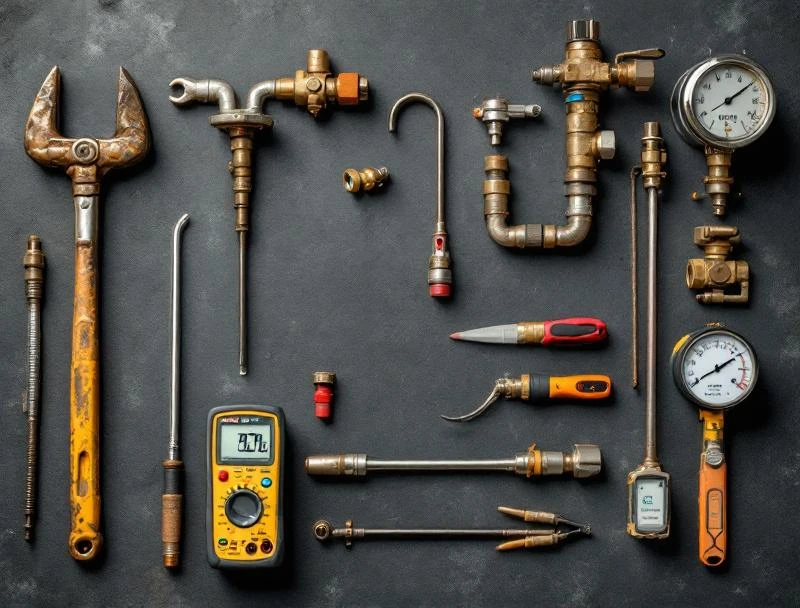
Diagnosis starts with the unit type, age, and presenting symptom. For gas tanks, we verify gas pressure with a manometer (typically 4-6” w.c. for residential), test thermocouple millivolt output (20-30 mV is normal for a healthy thermocouple), and inspect the burner for spider-web obstruction (a known issue with FVIR sealed combustion chambers in Tulsa garage installations).
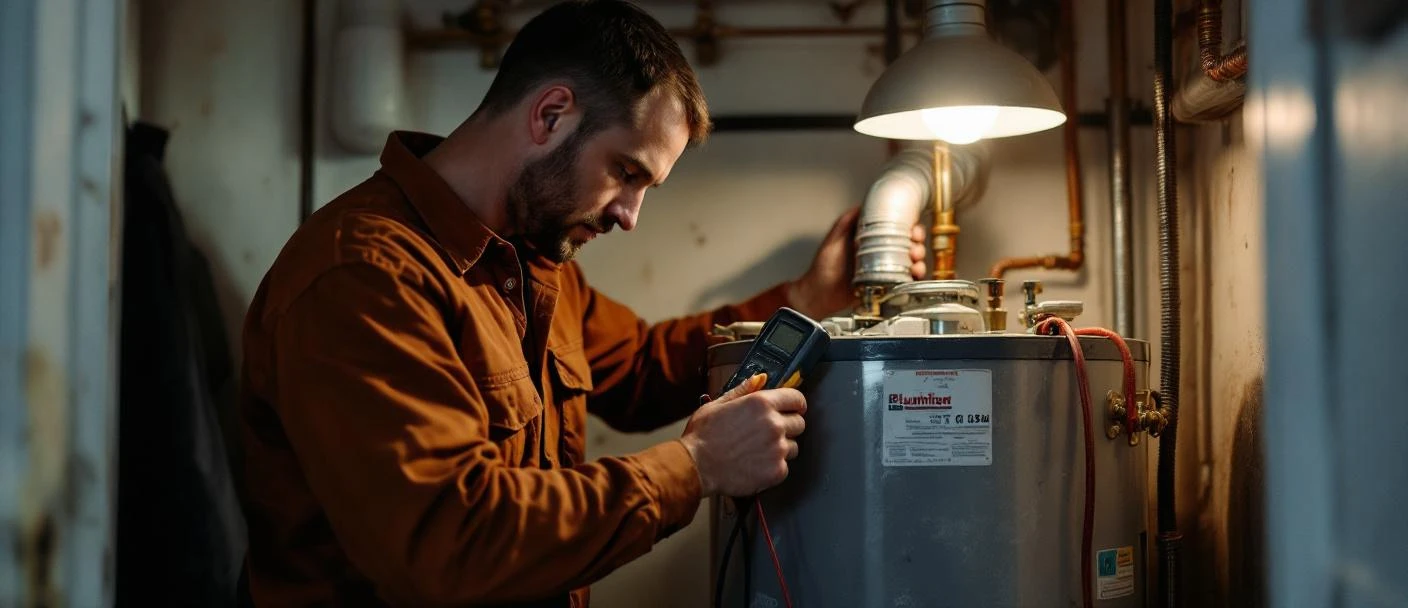
For electric tanks, we test heating element resistance with a multimeter — 10-16 ohms is normal for a 4500W/240V residential element. Failed elements often show open circuit (infinite resistance) or shorted circuit (low resistance to ground). Thermostats test similarly; a thermostat stuck closed is the cause of “water too hot” complaints, while stuck open produces “no hot water on lower element.”
For tankless units, we read the error code, isolate to gas/water/vent fault, and test components systematically. Heat exchanger inspection requires removing the front cover (Navien, Rinnai), descaling typically clears flow-restriction-related codes. Pressure switch and fan testing on power-vent and tankless units uses a manometer to verify draft pressure under operation.
Once diagnosed, repair work uses truck-stocked parts for common Bradford White, Rheem, A.O. Smith, Navien, and Rinnai service items. Anode rods, thermocouples, T&P valves, expansion tanks, and common element sizes ride on every truck.
Brands We Service Across Tulsa Homes
The dominant residential brands in Tulsa are Rheem (Performance Plus, Marathon, Professional Classic, Prestige, Gladiator, ProTerra hybrid), Bradford White (Defender Series, eF Series, AeroTherm hybrid, RG250H6N gas, Magnum Series), A.O. Smith (ProLine, Signature, Voltex Hybrid, Vertex Power Vent, Cyclone Mxi), State (Premier, Select, ProLine Master, GS6, GP6), and American (Pro Line, Premier, Pro Line Master).
Tankless penetration in Tulsa is highest in 74133 South Tulsa, 74137 Southern Hills, and 74008 Bixby. Navien (NPE-A2, NPE-S2, NCB-E combi), Rinnai (Sensei, Value Series, RU, RUC, RX), Noritz (NRC, EZTR40, EZ Series, ProTough), Bosch (Greentherm, Tronic series), and Takagi (TK series) are all serviced by our network. Stiebel Eltron (Accelera 220/300 hybrid, Tempra electric tankless) is occasional but covered.
Error codes vary by brand. Rheem tankless: 11 ignition fail, 12 flame loss, 13 false flame, 14 thermal fuse, 15 boiling protection, 16 outlet temp. Navien: 003 ignition fail, 010 fan, 027 abnormal flame, 38 dual venturi, 113 condensate, 109 air supply. Rinnai: 11 ignition, 12 flame loss, 14 thermal fuse, 25 condensate drain, 32 thermistor, 99 commercial. We carry the full chart on every truck.
How Tulsa Water Hardness Shapes Heater Lifespan
City of Tulsa Water reports 60-90 mg/L hardness — moderately soft, producing different scale-buildup pattern than Oklahoma’s harder small-town wells (often 200+ mg/L) or Cincinnati’s 120-150 mg/L water. The implications for water heater service: less aggressive sediment than truly hard markets, but still warrants annual flushing. Sediment displaces tank capacity, accelerates lower-element burnout in electric units, and produces the popping/rumbling sound during heating cycles.
The water source — surface water from Lake Spavinaw with Lake Eucha managed-flow secondary, processed at Mohawk WTP and A.B. Jewell WTP — has different chemistry than groundwater markets. Chloramination from the treatment plants affects copper supply lines downstream, which is why hot-side pinhole failures cluster near water heaters in pre-1990 copper distribution. The mildly aggressive water also accelerates anode rod consumption — magnesium anodes typically last 3-5 years in Tulsa water before needing replacement.
Magnesium anodes in Tulsa water occasionally produce a sulfur “rotten egg” odor through bacterial reaction with hydrogen sulfide; switching to aluminum-zinc or Corro-Protec powered anode resolves this where chlorination has dropped seasonally.
Pinhole leaks on the hot-side stub immediately downstream of the heater can mimic a tank leak, and slab leak repair scope picks up when the failure traces below the slab penetration instead of into the tank itself.
Oklahoma Code Requirements for T&P, Pan, and Vent
The Oklahoma Plumbing Code (UPC 2018 with state amendments) requires T&P discharge tube terminating within 6 inches of the floor or to an approved drain. Tulsa Codes & Construction Services flags this on every replacement permit. The discharge tube must be the same nominal size as the T&P outlet, must not be threaded on the discharge end (to prevent capping), and must terminate where discharge will be visible.
Tulsa garage installations of gas tanks must be FVIR-rated (Flammable Vapor Ignition Resistant) — older non-FVIR replacements without sealed combustion chambers fail inspection. The FVIR requirement protects against ignition of garage-floor flammable vapors (gasoline, paint thinner). Modern Bradford White Defender, Rheem FVIR, and A.O. Smith units all meet this requirement.
Closed-system water heaters (any home with a PRV at the meter, which is standard in Tulsa post-1990 construction) require a thermal expansion tank — without it, T&P drips chronically and the tank fails early. The expansion tank installs on the cold inlet line above the cold-side shutoff valve and is pre-charged to match the incoming line pressure (typically 60-65 psi).
Fixes a Homeowner Can Try Before Calling a Plumber
Before calling, check basic items: power to electric tanks (breaker tripped, disconnect switch off), gas supply to gas tanks (gas valve open at the unit and at the meter), thermostat setting (120°F is the standard target), and water supply (cold inlet shutoff fully open). For gas tanks with a pilot light, the relighting procedure is in the unit’s instruction sticker — typically push and hold the gas control knob in pilot position, light the pilot, and hold 30-60 seconds before releasing.
Sediment flushing is a reasonable DIY task with hand tools. Connect a garden hose to the drain valve, route the other end to a floor drain or outside, shut off the cold supply, open the drain valve, and let water run until clear. Total time 10-15 minutes for a 40-50 gallon tank. Repeat annually.
Element and thermostat replacement on electric tanks is feasible for homeowners comfortable with 240V circuits and tank draining. Always confirm power is off at the breaker with a non-contact voltage tester before opening the access cover. Gas valve, thermocouple, and pilot work involves combustion safety and is best left to a licensed plumber.
When You’re Better Off Replacing Instead of Repairing
The decision threshold: repair under $400 on a tank under 8 years old usually makes sense. Repair over $600 on a tank over 10 years old usually means replacement is the better value. Any visible rust at the base of the tank means replacement — the tank itself is failing and no component repair will extend service life meaningfully.
For tankless units, the calculus differs because the unit is so much more expensive. A failed heat exchanger (after warranty) on a Navien or Rinnai often runs $1,200-$2,000 in parts plus labour — close enough to full replacement cost that replacement with a newer-generation unit usually wins. For warranty-period failures, manufacturer parts coverage typically applies and repair is the right path.
Hybrid heat-pump water heaters are a special case. A failed compressor on a Rheem ProTerra or A.O. Smith Voltex is a $1,500+ component plus labour; the heat-pump section is more delicate than tank components and often the deciding factor in repair-vs-replace.
Catastrophic tank failure dumps 40-75 gallons before the supply can be shut, and Tulsa burst pipe repair scope handles the supply-side rupture and shutoff replacement when the heater itself is no longer the only damage.
Tankless Water Heater Service — Navien, Rinnai, Noritz, Bosch
Tankless service work in Tulsa concentrates on annual descaling and error-code diagnosis. Descaling involves circulating dilute white vinegar or a commercial descaler (CLR Pro) through the heat exchanger via the service valves — a 45-60 minute pump-circulation that dissolves mineral scale on the heat exchanger surface.
Error-code diagnosis follows the brand-specific code chart. Common Navien lockouts: 003 ignition fail (gas valve, igniter, or flame sensor), 010 fan (motor, bearing, or wire), 027 abnormal flame (combustion air or vent issue), 113 condensate (drain blocked), 109 air supply (intake blocked or restrictive). Common Rinnai lockouts: 11 ignition (gas valve or igniter), 12 flame loss (flame sensor), 14 thermal fuse (limit switch tripped), 25 condensate drain (blocked), 32 thermistor (sensor failure).
Heat exchanger replacement on out-of-warranty tankless units is rarely cost-effective. Service valve replacement (the brass valves on cold inlet and hot outlet) is occasionally needed when valves seize closed and prevent descaling. Condensate trap and drain line maintenance prevents the bulk of nuisance lockouts on condensing units.
Most failed tankless installs in 74133 trace to undersized existing gas line at 1/2 inch, and gas line repair Tulsa scope covers the upsize to 3/4-inch run with the BTU-and-length calculation that Rinnai or Navien specifies.
Power Vent Water Heater Diagnostic
Power vent units use a draft fan to push combustion gases out the vent rather than relying on natural draft. The fan motor and pressure switch are the most common failure points. Bradford White Defender, A.O. Smith Vertex, and Rheem Power Vent are the dominant residential power-vent platforms in Tulsa.
Diagnostic sequence: verify pressure switch operation with a manometer (typically 0.4-0.6” w.c. negative draft), test fan motor amperage (typically 1-2 amps at full speed), inspect vent run for blockage or condensate accumulation, check thermal limit switches. The pressure switch tubing often clogs with condensate over time, producing a false low-draft signal that locks out the unit.
Common in tighter post-1990 Tulsa homes where natural draft is insufficient and power vent provides reliable operation regardless of building envelope.
Anode Rod Replacement on a Tulsa Water Profile
Anode rod replacement is the single highest-leverage maintenance task for tank water heaters in Tulsa. The anode rod is a sacrificial metal rod (typically magnesium or aluminum-zinc) that corrodes preferentially to the tank’s steel walls. When the anode rod is depleted, tank corrosion begins.
In Tulsa’s moderately soft water, magnesium anodes typically deplete in 3-5 years. Replacement requires accessing the anode hex plug at the top of the tank (often hidden under a sheet metal cap), draining a few gallons to reduce internal pressure, and breaking the anode rod loose with an impact wrench — the threads are typically frozen by years of mineral deposit. Aluminum-zinc anodes are an alternative that resists the sulfur-odor reaction with sulfate-reducing bacteria. Powered anodes (Corro-Protec) use a low-voltage current to provide cathodic protection without sacrificing material.
A water heater with a fresh anode rod and annual sediment flush will reliably reach 12-15 years before tank failure. Without anode replacement, the typical Tulsa tank lifespan is 8-12 years.
Thermocouple Replacement
Thermocouple failure on standing-pilot gas tanks produces “pilot won’t stay lit” complaints. The thermocouple is a small probe in the pilot flame that generates 20-30 mV when heated; this millivolt output holds open the gas valve’s pilot solenoid. When the thermocouple fails (oxidation, wire fatigue, or burn-out), output drops below the threshold and the gas valve closes the pilot supply.
Diagnosis: with the pilot lit, measure thermocouple output at the gas valve connection. Below 18 mV, replacement is needed. Universal thermocouple kits fit most residential gas valves; Honeywell, White-Rodgers, and Robertshaw all make compatible parts. Replacement is straightforward — disconnect the old thermocouple at the valve, position the new one in the pilot flame, route the wire to the gas valve, and reconnect.
For modern electronic-ignition gas tanks, the equivalent component is the flame sensor (a flame-rectification probe) and the failure pattern is similar but diagnosis uses different tooling.
Heating Element Replacement on Electric Tanks
Electric tanks have two heating elements: an upper element near the top of the tank and a lower element near the bottom. Each is rated 4500W at 240V (standard residential), drawing about 19 amps. Element resistance reads 10-16 ohms with a multimeter; failed elements show open circuit (burned out) or shorted circuit (low resistance to ground).
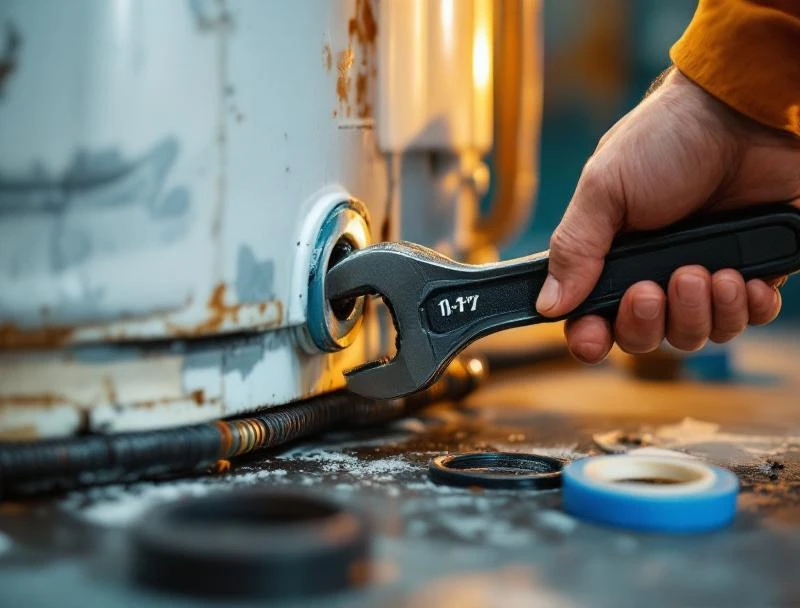
Replacement requires shutting off power at the breaker, draining the tank to below the element being replaced (lower element requires full drain), disconnecting the wires, and unscrewing the element with a 1-1/2” element wrench. The new element installs with a fresh O-ring gasket, gets re-tightened, and the wires reconnect.
Common in older 74133 South Tulsa with separate guest-wing heaters where dual-element cycling and dry-fire failures are more common. Dry-fire occurs when the tank is partially drained for service and power is restored before the element is fully submerged — the element burns out within seconds.
T&P Valve Replacement and Why It Drips
The temperature and pressure relief valve (T&P) is the safety device on every water heater. It opens automatically if tank pressure exceeds 150 psi or temperature exceeds 210°F, releasing water to prevent catastrophic tank rupture. T&P valves should be tested annually by lifting the lever briefly and confirming water discharge.
A T&P that drips chronically usually means upstream pressure or thermal expansion is too high, not that the T&P itself has failed. Watts 100XL and Cash Acme NCLX-3L are common Tulsa replacement parts. Replacement requires draining the tank below the T&P port, threading out the old valve, and installing the new with thread sealant tape.
The Oklahoma Plumbing Code requires the T&P discharge tube to terminate within 6 inches of the floor or to an approved drain, and the tube cannot be threaded on the discharge end. Replacements that change the discharge configuration trigger code review.
Expansion Tank Installation for Closed Systems
Tulsa homes with a pressure-reducing valve (PRV) at the meter — standard in post-1990 construction — operate as closed systems. Without an expansion tank, water heated in the tank has nowhere to expand and pressure rises until the T&P valve opens. The pattern: T&P drips intermittently, often during peak demand hours when heating cycles are active.
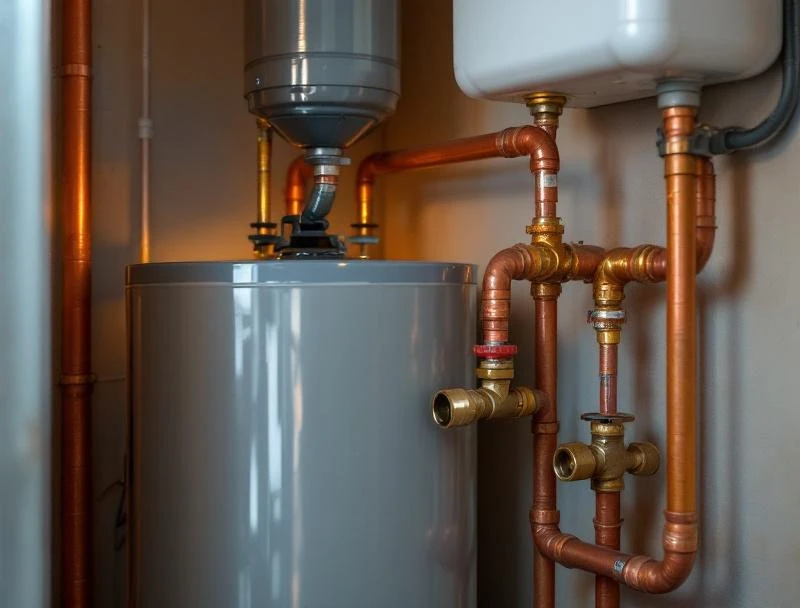
Expansion tank installation: a small bladder tank (typically 2-5 gallons for residential) installs on the cold inlet line above the cold-side shutoff valve. The tank is pre-charged to match the incoming line pressure (60-65 psi typical). When water in the tank expands, it pushes into the bladder rather than against the T&P relief.
Watts PLT-5, Amtrol ST-5, and Amtrol ST-12 are common residential sizes. The sizing depends on tank capacity and incoming pressure — 2-gallon for tanks up to 50 gallons, 4-5 gallon for larger tanks. Code requirement when PRV is present; we install on every replacement that triggers the requirement.
Water Heater Sediment Flushing
Annual flushing removes sediment that accumulates on the tank bottom. Procedure: shut off cold supply, connect garden hose to drain valve, route hose to floor drain or outside (downhill from the tank), open the drain valve, and let water run until it runs clear. Open a hot-side faucet upstairs to allow air into the tank during draining.
For heavy sediment loads, a partial fill-and-drain cycle helps — fill the tank halfway, then drain again, repeating until the discharged water runs clear. Some sediment clogs the drain valve itself; in those cases, removing the drain valve and replacing it during the flush is the right call.
For gas tanks with pilot lights, set the gas control to “pilot” position before draining to prevent the burner from cycling on a partially-filled tank. For electric tanks, shut off the breaker before draining to prevent dry-fire on the elements.
Recirculation Pump Issues
Recirculation systems keep hot water available at distant fixtures by continuously cycling water through a return line back to the heater. Common in 74133 South Tulsa and 74137 Southern Hills large homes with multiple bathrooms and long supply runs.
Grundfos UP15-10, Taco 006, and Watts Premier are the dominant residential recirculation pumps. Failure modes: bearing seizure (motor whine, no flow), cartridge failure (intermittent operation), thermostat (aquastat) malfunction (always-on or never-on operation). Diagnosis is straightforward — verify electrical power, listen for motor operation, feel return line for warm water flow.
Pump replacement is typically a 1-1.5 hour job. Cartridge replacement (where supported) is faster. A failed recirc pump produces “no instant hot water” complaints often misdiagnosed as heater failure — verify pump operation before condemning the heater.
Hybrid Heat Pump Water Heater Service
Hybrid heat-pump water heaters use refrigerant-cycle heat transfer to move ambient air heat into the tank. Rheem ProTerra (formerly Performance Platinum HPWH), A.O. Smith Voltex, Bradford White AeroTherm, and Stiebel Eltron Accelera are the dominant residential platforms.
Operating range is 40-90°F ambient air. Outside this range, the unit reverts to resistance-only mode (essentially functioning as an electric tank water heater). Tulsa garage installations often exceed 100°F summer ambient, occasionally cycling the unit into resistance-only mode and increasing energy consumption substantially.
Service work includes filter cleaning (typical interval 6-12 months), refrigerant leak diagnosis (rare but possible), compressor diagnosis (high cost component), and condensate drain maintenance. Increasingly common in post-2018 Tulsa builds and energy-conscious retrofits.
Tulsa-Specific Factors That Shape Water Heater Repair
Tulsa garage installations of gas tanks must be FVIR-rated. Older non-FVIR units in pre-2003 garage installations (legal at original installation, grandfathered for replacement) are actively being replaced as they fail — Tulsa Codes & Construction Services enforces FVIR requirement on all replacement permits.
Closed-system water heaters with PRV at the meter — standard in 74012 Broken Arrow, 74008 Bixby, 74055 Owasso, and 74037 Jenks post-2000 construction — require expansion tank installation. Older homes in 74104 Cherry Street, 74114 Maple Ridge, and 74105 Brookside without PRV at the meter run as open systems and don’t require the expansion tank, though pressure regulation is still recommended.
Polybutylene supply piping into pre-1995 Tulsa water heaters (74104 Cherry Street, parts of 74105 Brookside) often necessitates supply-side repipe during heater replacement — adds $400-$1,200 to job scope. Hybrid heat-pump installs in 74133 South Tulsa garage spaces frequently exceed the 90°F ambient ceiling during summer; relocation to conditioned space is the typical resolution.
Oklahoma Plumbing Context for Water Heater Work
Oklahoma Construction Industries Board (CIB) licensing applies to all water heater installation and repair work involving gas connections or significant plumbing work. The Oklahoma Plumbing Code (UPC 2018) governs T&P discharge, expansion tank requirements, vent termination, and FVIR compliance for garage installations.
Tulsa Codes & Construction Services issues permits for water heater work inside city limits when the scope triggers permit requirements. Surrounding suburban authorities have their own permit processes. Oklahoma Natural Gas (ONG) owns the gas service to the meter; the customer owns the gas line from the meter forward. ONG handles emergency leak response on their side; licensed plumbers handle customer-side gas work.
When hiring any contractor for water heater work, verify CIB credentials at cib.ok.gov, request bonding and insurance certificate, and confirm the permit will be filed in your name as homeowner. Our network handles permits and inspection coordination as part of standard repair scope.
If the tank let go in the middle of the night, our Emergency Plumber Tulsa team is the same dispatch that handles bursts, slab leaks, and sewer backups across the metro every hour of the year.