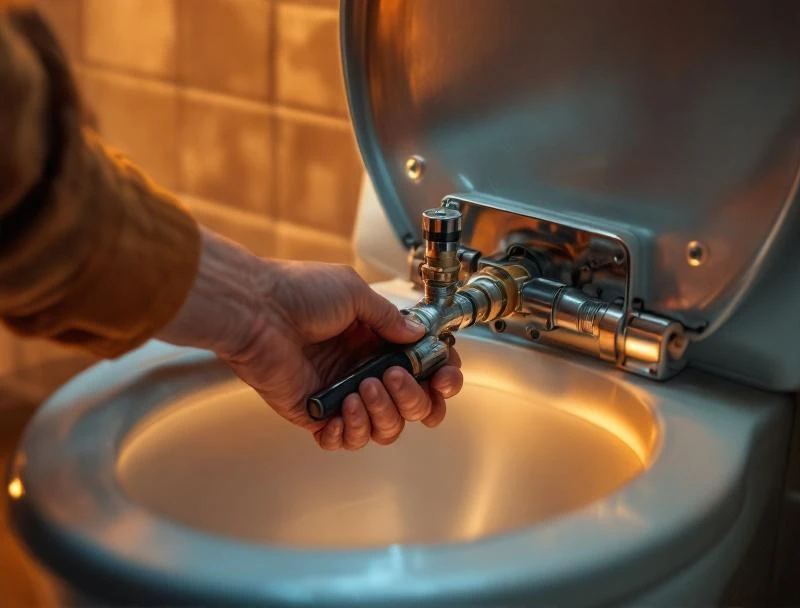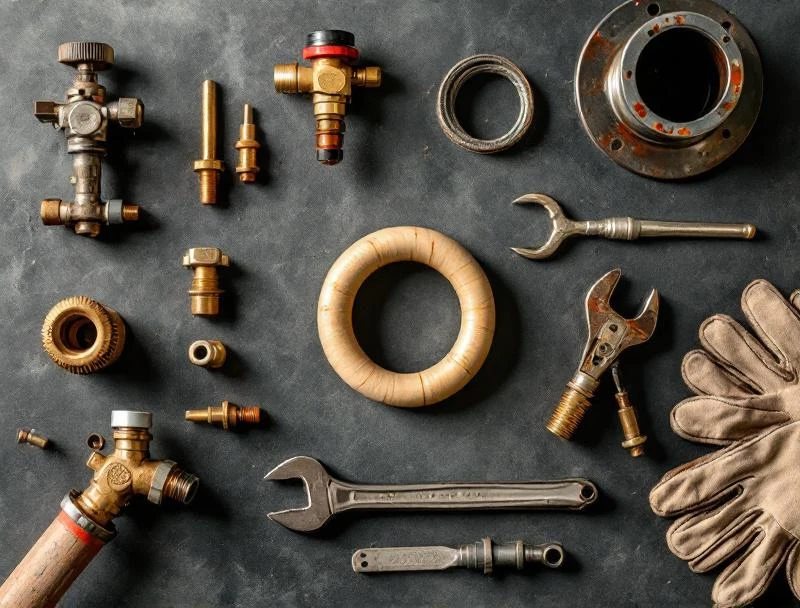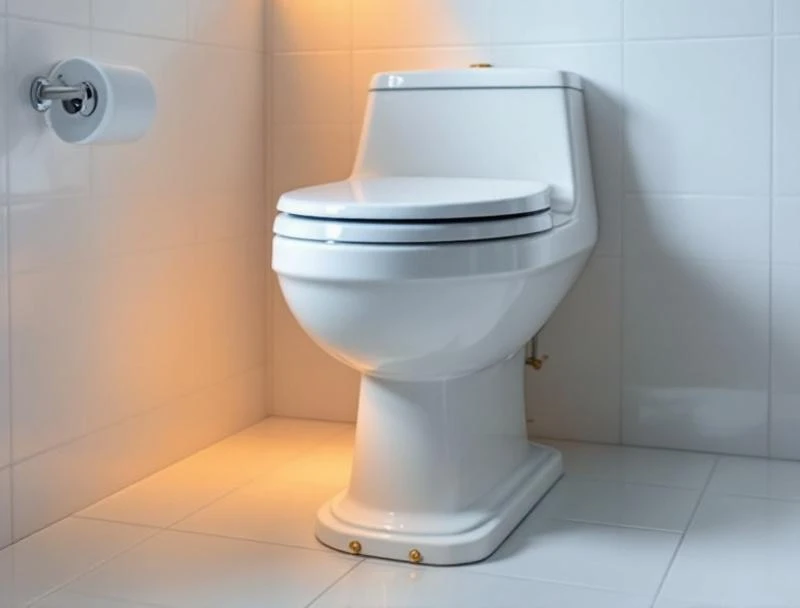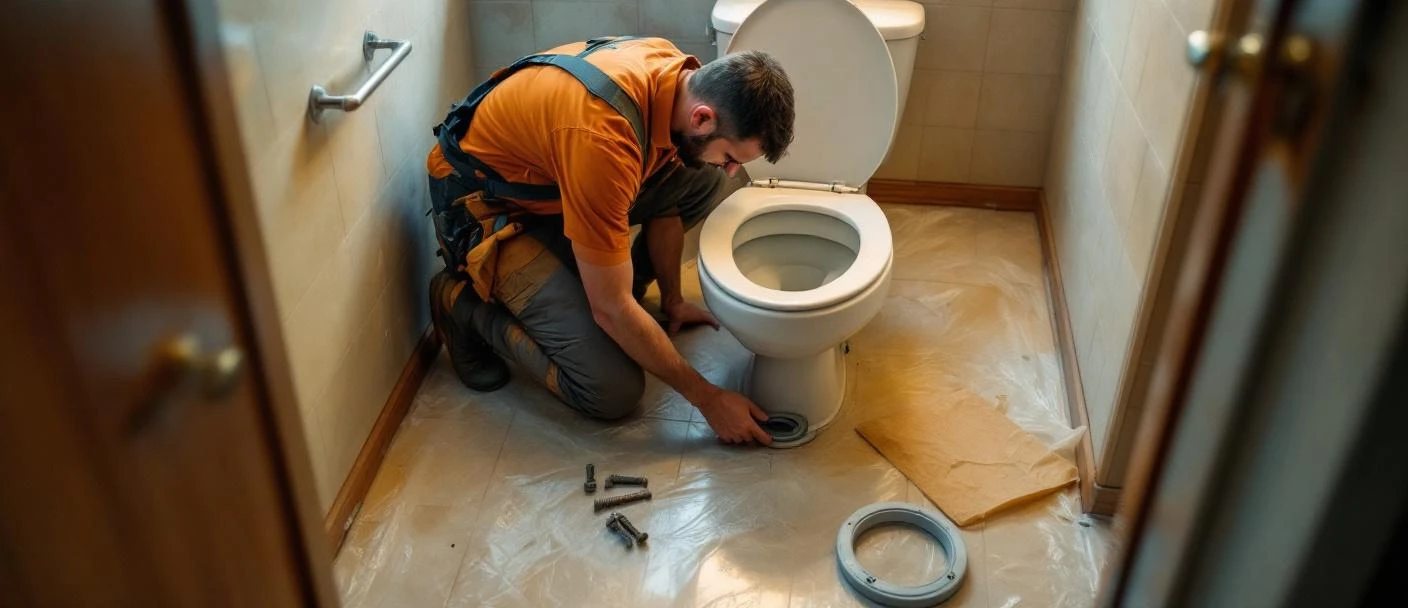
A toilet repair Tulsa call is the most universal household plumbing service. Every Tulsa home has 2-4 toilets, the average toilet runs through 5-10 flush cycles per day, and the standard internals (flapper, fill valve, flush valve) reach end of service life every 5-10 years. This page covers every common toilet failure mode — running, leaking, rocking, clogged, weak-flushing — and the brand- and configuration-specific repair scope our Tulsa network handles.
The high-leverage facts: a continuously running toilet wastes 1-4 gallons per minute and can add $50-$200/month to your City of Tulsa Water bill. Pre-1940 homes commonly have closet flanges set below finish floor due to flooring updates over decades — wax rings fail prematurely without a flange extender. Lead-bend toilet drains in pre-WWII Tulsa require careful pull-and-reset to avoid fracturing the lead joint. Modern code (Oklahoma UPC 2018) requires 1.28 GPF maximum for new residential toilet installations.
What a Toilet Repair Costs Across Tulsa Service Calls
Standard pricing for the most common Tulsa toilet repairs: flapper replacement only $120-$180, full rebuild kit (flapper, fill, supply) $180-$320, wax ring replacement (toilet pulled and reset) $180-$340, toilet flange repair $280-$650, angle stop replacement $150-$280, toilet auger service $180-$300.
Replacement pricing: standard 1.28 GPF toilet (mid-range Kohler / American Standard) $400-$750 installed; comfort-height TOTO Drake or Kohler Cimarron $550-$950 installed; Saniflo upflush system for basement bathrooms $1,800-$3,500 installed. Cracked tank emergency response $250-$450 for tank-only or full unit replacement.
After-hours pricing adds a $150-$250 trip charge to the standard service total. Most toilet repairs complete in a single visit with truck-stocked parts.
Why a Running Toilet Wastes More Water Than You Think
A running toilet flowing 1 gallon per minute wastes 1,440 gallons per day, roughly 43,000 gallons per month. At Tulsa water rates, that’s a $50-$200/month surcharge on your bill before you discover the leak. Ghost-flushing toilets that refill every few hours waste less but still add up over months.
The diagnostic test: drop food coloring in the tank, wait 30 minutes without flushing, then check the bowl. Color in the bowl means the flapper isn’t sealing — water leaks past it from tank to bowl, lowering the tank water level until the fill valve triggers a refill cycle. The cycle repeats every few hours.
Less common causes of constant running: failed fill valve (unable to shut off when tank is full), refill-tube routed into the overflow tube (causing siphon-feed of bowl), or a flush-valve seat that’s pitted from age and won’t seal even with a fresh flapper.
Inlet valve failure across multiple toilets at once usually traces to a failing pressure-reducing valve, and PRV replacement in Tulsa fixes the upstream cause that constant fill-valve replacement won’t.
How Our Plumbers Diagnose a Leaking, Rocking, or Running Toilet
Diagnosis sequence: visually inspect tank internals with the cover off, check for water on the floor at the base (wax ring failure or supply leak), test the angle stop for proper operation, run the food-coloring test for flapper-seal verification, and check the supply line for braided-stainless integrity.
For leaking-at-base symptoms, the wax ring is the dominant failure mode. Pull the toilet, inspect the flange for damage, replace the wax ring with a fresh one (or a waxless gasket like Danco Perfect Seal), reset the toilet, and re-tighten the closet bolts evenly. If the flange is set below finish floor, install a flange extender ring before reset.
For rocking, shim the toilet base level with Hercules Sturdy Shim wedges, then caulk the perimeter or leave un-caulked per local preference. Caulking has both pros (seals against floor moisture) and cons (hides developing wax-ring leaks until subfloor damage is significant).
Toilet Brands and Parts We Stock for Tulsa Homes
Dominant brands in Tulsa: TOTO (Drake, Eco Drake, UltraMax II, Aquia), Kohler (Cimarron, Highline, Wellworth, Memoirs, Veil), American Standard (Champion 4, Cadet 3, H2Option dual flush), Mansfield (Alto, Pro-Fit, Summit), Niagara (Stealth ultra-high-efficiency).
Parts manufacturers: Fluidmaster (fill valves 400A/400H, flush valves PerforMAX, flappers), Korky (flappers, QuietFill fill valves, flush valves 528), Danco (Perfect Seal waxless gasket), Hercules (closet bolts, shims, sealing wax), Sioux Chief (closet flange, repair ring 886), Oatey (closet flanges, bolts, wax).
For basement and below-grade installations, Saniflo (SaniBest grinder), Liberty Pumps (LE71 ejector), and Zoeller (267 ejector) are the dominant macerator and ejector platforms.
Why Old Tulsa Wax Rings Fail Faster on Cast Iron Flanges
Pre-1940 Tulsa cast iron closet flanges (in Cherry Street 74104, Maple Ridge 74114, Pearl District 74120) often sit below finished tile floor due to flooring updates over decades. When tile is added on top of original wood floor, the flange height stays the same but the floor surface rises — and the wax ring no longer compresses properly between toilet base and flange.
The fix: install a flange extender ring (Sioux Chief 886) that provides a new bolt slot and seal surface at the correct height relative to the new floor. This avoids floor demolition while restoring proper wax-ring compression.
Lead-bend toilet drains in pre-WWII Tulsa add another wrinkle. Lead is malleable and can fracture under aggressive wax cleanup or improper bolt-tightening. Careful work — gentle wax removal, steady bolt-tightening to manufacturer torque, and avoidance of leverage on the lead — preserves the lead bend through the repair.
Oklahoma Code Updates That Affect Toilet Replacement
The Oklahoma Plumbing Code (UPC 2018 + state amendments) adopts 1.28 GPF maximum for new toilet installations. Pre-1994 high-flow toilets (3.5+ GPF) cannot be installed as new replacement work — they’re only legal in original installation. When replacing a high-flow toilet, the new fixture must meet 1.28 GPF or 1.6 GPF maximum depending on installation date.
ADA comfort-height requirements (17-19 inch rim) apply to commercial and accessible installations; residential applications can choose comfort-height or standard-height. Tulsa Codes & Construction Services issues permits for toilet replacement scope when the work involves drain-line modification or relocation; like-for-like replacement in the same location often falls under minor work without permit.
DIY Repairs That Work and Repairs That Make It Worse
DIY-appropriate scope: flapper replacement (under $15 in parts, 30-minute job), fill valve replacement (under $25 in parts, 45-minute job), supply line replacement (under $20 in parts, 15-minute job), simple toilet auger clog clearing (rental from hardware store handles most reachable clogs).
Borderline scope: full rebuild kit installation (more parts to manage, potential for cross-thread on tank-to-bowl bolts), toilet replacement (proper wax-ring placement, level toilet, even bolt-tightening matter for long-term reliability).
Pro-only scope: flange repair or replacement (drain-line modification, code compliance), Saniflo or ejector pump installation (electrical and drain-line coordination), basement bathroom retrofits (drain re-routing, code permit), aging-in-place comfort-height upgrades when ADA compliance matters.
DIY mistakes that escalate cost: overtightening closet bolts (cracks porcelain), forcing seized angle stops (strips the stem, requires emergency shutoff at main), reseating with a damaged wax ring (leaks into subfloor over months before discovery), and using chemical drain cleaner in a clogged toilet (damages internal seals on adjacent fixtures).
When a Toilet Overflow Means Stop and Call
Active toilet overflow with sewage backflow is a stop-immediately situation. Shut the angle stop at the base of the toilet (clockwise to close); if the angle stop is seized or missing, shut at the main. Continuing to flush worsens the overflow and increases contamination scope.
For a slow-rising bowl, stop using the toilet and contact us before the next flush. We coach the angle-stop shutoff while a truck rolls. For a backed-up bowl that won’t drain (clog), do not flush — added water has nowhere to go. Use a heavy-duty plunger or wait for the auger.
A toilet that backs up with no obstruction in the bowl usually points to the branch or main downstream, and Tulsa drain cleaning scope picks up the cleanout-side cabling and camera.
Flapper Replacement and Ghost-Flushing Diagnosis
Flappers are the rubber valve at the bottom of the tank that lifts when you flush and reseats afterward. They’re the highest-failure component in toilet internals — typical service life 3-5 years before the rubber hardens, warps, or the chain hangs up.
Ghost flushing diagnosis: drop food coloring in the tank, wait 30 minutes without flushing, check the bowl. Dye in the bowl confirms flapper-seal failure. Some flappers warp from chlorine exposure (city water with high chloramine levels accelerates this), others from chain-hang-up at the wrong angle.
Replacement: shut off the angle stop, flush to drain the tank, sponge residual water, unhook the chain and flapper from the flush valve, install a new flapper (Korky, Fluidmaster, or OEM brand-specific), restore water, and test the flush. 30-45 minute job for a homeowner with basic tools.
Fill Valve Replacement
Fill valves control water inflow to the tank. Fluidmaster 400A/400H, Korky QuietFill, and Kohler internal kits are the dominant residential parts.
Failure modes: hisses constantly (failed seal at top of valve), refills slowly (debris in valve), won’t shut off completely (failed inlet seal), or never refills (debris blocking inlet). Replacement is straightforward — shut off angle stop, drain tank, disconnect supply line, unscrew the lock nut from below the tank, lift out the old valve, install new with appropriate height adjustment, reconnect supply, and test.
A new fill valve typically costs $15-$25 in parts. Labour for installation runs 30-45 minutes. Bundled with flapper replacement (full rebuild kit) is the most efficient repair when both have aged out.
Flush Valve Replacement
Flush valves are the larger seat at the bottom of the tank that the flapper covers. They’re typically reliable for 15-25 years, but age eventually pits the seat surface and even fresh flappers can’t seal completely.
Replacement requires removing the tank from the bowl (loosening the tank-to-bowl bolts and lifting the tank). The flush valve unscrews from below the tank with a large slip-nut wrench. Fluidmaster PerforMAX and Korky 528 are the most common residential flush-valve replacements.
Total time: 1.5-2 hours including tank removal, replacement, and reset with new tank-to-bowl gasket. Often bundled with full toilet rebuild when flapper replacement alone won’t seal due to aged flush-valve seat.
Wax Ring Replacement
Wax ring is the seal between toilet base and closet flange. The mechanism: the toilet base sits on a wax compression ring that conforms to both surfaces, sealing against waste-water leakage. Wax compresses fully on installation and stays compressed indefinitely under normal use.
Failure modes: shifted toilet (rocking) breaks the wax compression seal; inadequate compression at install allows seepage; flange below finish floor leaves the ring under-compressed; cracked flange allows the ring to sag.
Replacement: shut off angle stop, flush to drain bowl, sponge water, disconnect supply line, remove closet bolts, lift the toilet straight up off the flange. Scrape old wax from flange and toilet base, inspect flange condition, install new wax ring (or Danco waxless gasket), reset toilet on fresh ring, snug closet bolts evenly, restore water, and test.
Wax-ring failures leak slowly into subfloor without visible bowl leakage, and toilet leak detection runs moisture-meter mapping under the flange to confirm before the bowl gets pulled.
Toilet Flange Repair
Closet flange repair scope spans simple flange-extender rings to full flange replacement. Sioux Chief 886 repair ring bolts over the existing flange to provide new bolt slots and a proper sealing surface at the correct height — works for flanges that are cracked, broken, or set slightly below finish floor.
Full flange replacement requires drain-line access. For homes with crawlspaces or basements, access from below is straightforward. For slab-on-grade homes, access requires breaking the floor or accessing through the toilet hole — significant labour scope. Tile vs wood subfloor changes the access approach.
Common in pre-1940 Tulsa homes after multiple floor-tile updates raised the floor surface above the original flange. Common in pre-1960 cast iron drains where corrosion has compromised the flange seat.
Toilet Bolt Replacement
Closet bolts hold the toilet to the flange. Brass closet bolts (T-shaped head with threaded shaft) thread into slots on the flange. Stainless steel is an alternative for high-moisture environments.
Failure modes: snap-off plastic caps lost or broken (cosmetic), bolt threads stripped (toilet won’t snug down), bolt rusted to the flange slot (won’t loosen for toilet removal). Replacement requires accessing the bolts (remove caps), trying to loosen with hand tools, and cutting with a hacksaw or mini-saw if seized.
Standard residential closet bolts run $5-$12 in parts. Replacement is part of any wax-ring service or toilet replacement.
Supply Line Replacement
Supply lines connect the angle stop to the toilet’s fill valve. Braided stainless steel is the modern standard — flexible, freeze-resistant, and rated for residential pressures. Older homes may have rigid copper or chrome-plated supply that’s outlived its useful service.
3/8” compression × 7/8” ballcock connection is the standard residential size. Replacement is straightforward — shut off angle stop, disconnect old supply at both ends, install new with appropriate adapter if needed, restore water and test.
A new braided stainless supply runs $10-$20 in parts. Common bundled service with other toilet repair work.
When the supply line behind the wall ruptures during a freeze, burst pipe repair Tulsa scope picks up the supply rupture before the toilet bowl gets re-set.
Angle Stop Replacement
Angle stops are the local shutoff valve below the toilet (or under sinks). Pre-1960 Tulsa homes commonly have multi-turn compression angle stops that have seized over decades. Modern quarter-turn ball valves are more reliable and easier to operate.
Replacement requires shutting off at the main, draining the line, disconnecting the supply line, and replacing the angle stop. Soldered, SharkBite push-fit, and compression connections all work depending on the existing supply pipe material.
Quarter-turn ball-valve angle stops cost $10-$20. Total time 45-60 minutes. Common bundled service when a toilet repair reveals a seized angle stop that won’t operate.
Ghost Flushing Diagnostic
Ghost flushing means the toilet refills spontaneously every few hours without anyone flushing. Causes: flapper-seal failure (most common), refill-tube routed into the overflow tube (causing siphon-feed), or a pitted flush-valve seat that no flapper can seal.
Diagnosis: food-coloring tank test confirms flapper-seal failure. Refill-tube position check — the tube should clip to the overflow tube but not reach inside it. Visual inspection of the flush-valve seat for pitting or rough surface.
Resolution depends on cause. Flapper replacement for the common case. Refill-tube clip repositioning for the routing issue. Flush-valve replacement for pitted seat. Verify with re-test of the food-coloring procedure.
Weak-Flush Diagnostic
Weak-flush symptoms: bowl doesn’t fully evacuate, multiple flushes required, slow flush start. Causes: partial flapper close (chain too short or flapper too small for flush valve), low water level in tank (refill-tube routing or fill-valve setting), calcified jet/rim holes (sediment buildup in tank reduces effective flow), or weak flapper buoyancy (waterlogged flapper).
Diagnostic sequence: visually verify flapper opens fully on flush, check tank water level (should be at the marked fill line), inspect rim holes around the bowl interior for mineral buildup, and verify refill-tube clip position. Most weak-flush issues resolve with flapper-and-fill rebuild plus rim-hole cleaning with a wire brush.
Toilet Rocking Repair
Toilet rocking means the wax-ring seal will eventually fail. Causes: closet flange below finish floor (most common in pre-1940 Tulsa), uneven floor surface, compressed wax ring (improper original install), or broken flange.
Repair: pull the toilet, inspect flange height relative to finish floor, install flange extender if flange is below floor, replace wax ring, reset toilet on level surface with Hercules Sturdy Shim wedges where needed, snug closet bolts evenly. Caulk perimeter or leave open per local preference and homeowner choice.
Comfort-Height and Dual-Flush Upgrades
Comfort-height toilets (17-19 inch rim) are increasingly preferred for aging-in-place upgrades. TOTO Drake Comfort Height, Kohler Cimarron Comfort Height, American Standard Cadet 3 Right Height are dominant Tulsa installations.
Dual-flush (separate full and partial flush buttons) saves water on liquid-only flushes. TOTO Aquia, Kohler dual-flush, American Standard H2Option are common installations. Combined comfort-height + dual-flush units offer both ergonomic and water-saving advantages.
Tulsa demographic skew toward older residents in 74135 Patrick Henry, 74137 Southern Hills, and 74133 South Tulsa makes comfort-height a frequent upsell during otherwise-routine toilet replacement.
Tulsa-Specific Factors That Shape Toilet Repair
City of Tulsa Water at 60-90 mg/L hardness produces moderate scale on flush-valve seats over 5-7 years. A “won’t stop running” call after that interval is usually flush-valve seat, not flapper alone. The Lake Spavinaw / Lake Eucha source water also affects rim-hole calcification rate — annual cleaning extends flush performance.
Pre-1940 Tulsa cast iron closet flanges in Cherry Street 74104, Maple Ridge 74114, Pearl District 74120 often sit below finished tile floor — wax rings fail prematurely without flange extender. Lead-bend toilet drains in pre-WWII stock require careful pull-and-reset.
74133 South Tulsa large homes commonly have 3+ toilets — multi-fixture rebuild calls common at the 8-12 year mark. 74012 Broken Arrow post-2000 PVC closet flanges occasionally fracture under settling — flange replacement scope more common than wax-ring-only failures.
Oklahoma Plumbing Context for Toilet Work
Toilet repair scope generally falls below the Oklahoma CIB licensing threshold for residential like-for-like replacement. Drain-line modification, flange relocation, and Saniflo upflush installation cross into licensed-plumber territory. Oklahoma Plumbing Code mandates 1.28 GPF maximum for new toilets and ADA-compliant comfort-height in accessible installations.
Tulsa Codes & Construction Services handles permits when scope triggers. Suburban authorities in Broken Arrow, Bixby, Jenks, Owasso each have their own permit thresholds. We file permits where required and handle inspection coordination as part of standard repair scope.
An overflow at 11pm is exactly when our Emergency Plumber Tulsa team is dispatched, because a stuck flapper or cracked tank doesn’t wait for office hours.