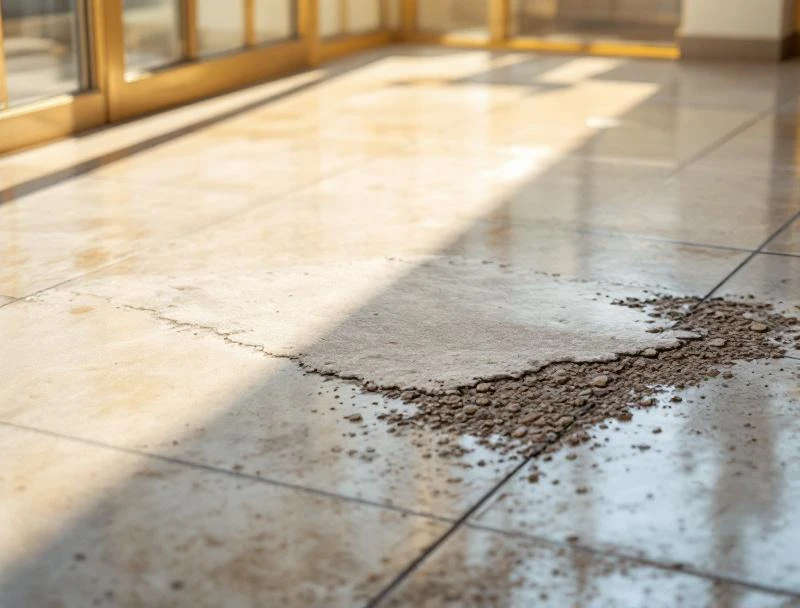
A slab leak repair Tulsa call is one of the most distinctively Tulsa plumbing scopes. Post-1960 development across the metro is overwhelmingly slab-on-grade construction, and Oklahoma’s expansive red-clay soil cycles seasonally — driving slab-leak frequency far above pier-and-beam markets. 74133 South Tulsa, 74137 Southern Hills, 74135 Patrick Henry, and the post-1990 PEX-era subdivisions of 74012 Broken Arrow, 74008 Bixby, 74055 Owasso, 74037 Jenks all sit on slab-on-grade.
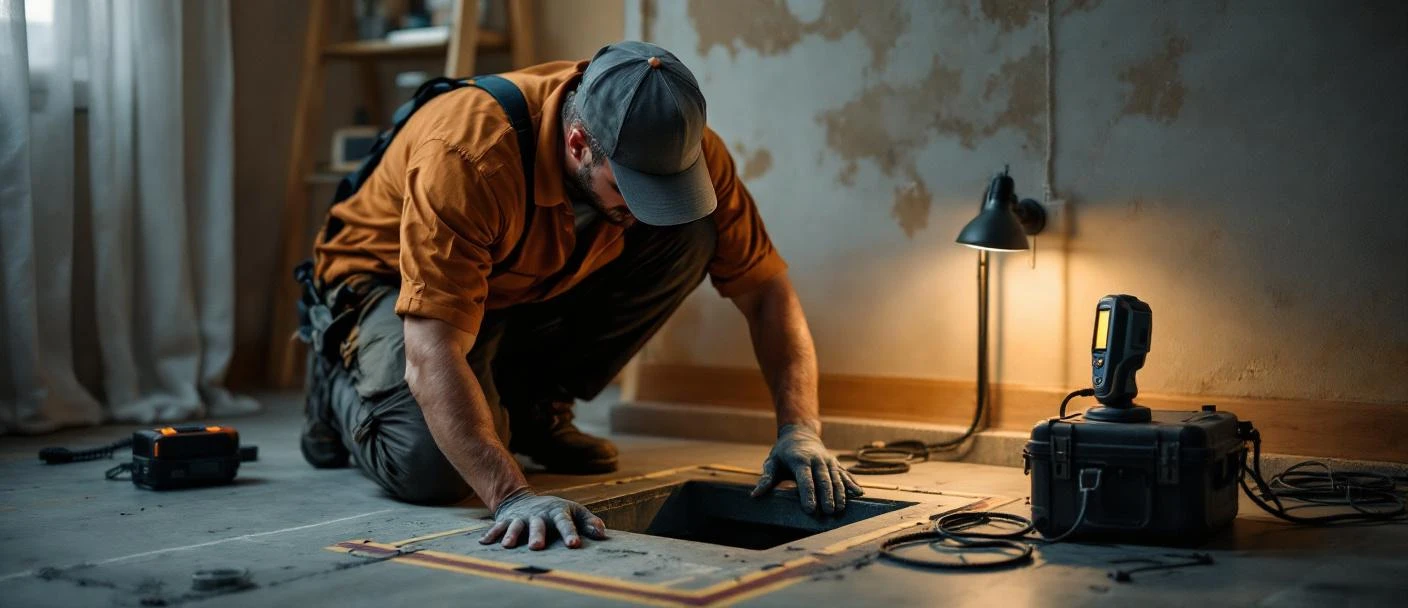
The diagnostic-and-repair workflow starts with non-destructive location — acoustic listening, thermal imaging, and tracer gas detection — before any concrete is cut. Once located, the homeowner has options: spot repair through the slab, reroute through attic or walls, or in-place epoxy lining. Each has a fit. We assess all three and recommend the best technical and economic choice.
What Slab Leak Repair Costs in a Typical Tulsa Home
Detection scope: acoustic + thermal $400-$800, adding tracer gas $700-$1,400. Spot repair through accessible slab $1,800-$3,500; deeper or complex access $3,500-$6,500. Reroute single line through attic $1,800-$3,200; whole-home manifold replumb $7,500-$15,000. Epoxy pipe lining (ePIPE / Nu Flow, single line) $3,500-$7,500.
Concrete patch and basic floor restoration after spot repair runs $300-$600. Tile and hardwood restoration are typically separate from plumbing scope and coordinated with restoration contractors. Insurance documentation is included with every slab repair package.
After-hours pricing adds a $150-$250 trip charge to detection or repair scope. Most slab leak detection completes in a single visit; repair scope often spans multiple visits depending on chosen approach.
When the leak signature comes from above the slab in a wall cavity, the failure mode shifts to Tulsa burst pipe repair scope and the wall-cut diagnostic replaces the slab acoustic locate.
How a Slab Leak Shows Up Before You See Standing Water
The earliest signs of a slab leak in a Tulsa home are subtle. Warm spot on tile or carpet floor — hot-side leak signature, the leaking water heats the slab above. Unexplained water bill spike — pressurized supply leak adds gallons-per-hour to the meter. Sound of running water with all fixtures off — characteristic high-pitched hiss audible in quiet conditions, especially overnight. Hot water that doesn’t last as long — hot-side leak depleting the tank.
Visible-water symptoms appear later: damp carpet at slab edge, tile efflorescence (white powdery mineral deposits at joints), mildew smell in fabric and carpet, foundation cracks that develop or widen seasonally. Once visible water shows, the leak has been progressing for weeks or months.
For 74133 South Tulsa and 74137 Southern Hills, the dominant signal is hot-side because the pre-1990 copper distribution sees electrolytic attack from chloraminated water from the Lake Spavinaw / Lake Eucha watershed. Hot-side leaks produce the warm-spot symptom; cold-side leaks need thermal contrast or tracer gas.
How Our Plumbers Locate the Leak Without Jackhammering Everything
The diagnostic sequence: pressurize and isolate hot side vs cold side at the manifold, listen acoustically for leak signature with SubSurface LD-12 or Goldak 902B ground microphone, scan thermally with FLIR E8 Pro or FLIR E96 for hot-side signature, and inject tracer gas (5% hydrogen / 95% nitrogen forming gas) when acoustic and thermal are inconclusive. Each method has a fit; combining them gives reliable location to within 6-12 inches.
Acoustic listening picks up the hiss of pressurized water escaping through a small hole. The pipe-in-slab acts as a sounding chamber; the leak signature transmits through the concrete to the surface where a ground microphone with headphones can detect it. Frequency filtering on modern equipment isolates the leak signature from ambient noise (HVAC, traffic, refrigerator).
Thermal imaging picks up the temperature gradient on the slab surface above a hot-side leak. Hot water leaking under tile produces a measurable surface-temperature pattern detectable with a 0.05°C-resolution thermal camera. Cold-side leaks produce no thermal contrast and require alternative methods.
Tracer gas (5% hydrogen / 95% nitrogen forming gas) is injected into the supply system after isolation. The gas escapes through the leak and is detected at slab or wall surface with a semiconductor sensor (Sensit HXG-3) sensitive to parts-per-million levels. Gold standard for cold-side leaks where thermal fails.
Acoustic and thermal location is the entire game, and leak detection Tulsa OK scope is the diagnostic deliverable that often stands alone before any slab cut is approved.
Spot Repair vs Reroute vs Epoxy Lining for a Tulsa Slab
Spot repair opens the slab at the located leak point, accesses the pipe, replaces the failed section with a soldered coupling or ProPress fitting, pressure-tests the repair, and patches the slab. Best for single isolated leaks where the pipe is otherwise sound. Risks: discovering additional leaks during access (extending scope), damaging adjacent finished surfaces (tile, hardwood), and the certainty that any concrete patch will be visible.
Reroute abandons the slab line at the point of leak, caps both ends, and runs new PEX-A through attic or wall cavities to the fixture. Best for multiple leaks (where spot repair isn’t economical), for homes where attic access is convenient, and for situations where homeowner wants to avoid concrete cutting entirely.
Epoxy pipe lining (ePIPE / Nu Flow) restores the existing pipe in-place. The line is dried, sandblasted internally, then a two-part epoxy coating applied via airflow. The cured coating creates a structural pipe-within-a-pipe with 50-year manufacturer service life. Best for multiple-line restoration where reroute would be impractical, and for slab homes with complex layout that complicates reroute paths.
Why Oklahoma Expansive Soil Causes Slab Leaks Predictably
Oklahoma red-clay soil swells and shrinks seasonally with moisture content. The cycling produces 4-6% volumetric change between summer dry and winter wet conditions. For slab-on-grade homes, this means the foundation rises and falls — and any pipe penetrating the slab experiences cyclical stress at the penetration point.
Pre-1985 amendments to the Oklahoma Plumbing Code didn’t require sleeved slab penetrations to protect supply lines from concrete attack and movement. Older Tulsa homes built before this requirement often have pipes in direct concrete contact, accelerating corrosion at the penetration. Post-1985 amendments require sleeves, and post-1985 slabs typically have better long-term pipe survival.
The result: predictable slab-leak demand in 74133 South Tulsa, 74137 Southern Hills, 74135 Patrick Henry at the 30-50 year mark where copper pinhole leaks become routine. Newer 74012 Broken Arrow and 74008 Bixby post-2000 PEX construction sees fewer slab leaks per capita because PEX flexes with soil movement instead of fatiguing — but expansion-fitting failures still occur.
Permits, Insurance, and Code on Slab Leak Work in Tulsa
Tulsa Codes & Construction Services issues permits for slab repair scope. Spot repair through slab and reroute work both typically trigger permit requirements. The Oklahoma Plumbing Code (UPC 2018) governs material selection, slab penetration sleeving, and code-compliant pipe support spacing.
Oklahoma CIB licensing applies to all slab leak repair work — verify any contractor’s license at cib.ok.gov. Bonding and insurance requirements protect homeowners against contractor failure.
For insurance: standard HO-3 policies in Oklahoma typically cover resulting water damage but not the pipe repair itself. The framing matters. Document the leak with date-stamped thermal images, acoustic-locate marks on a sketch of the affected area, and moisture-meter readings. We provide complete documentation packages structured for insurance submission.
When a Damp Carpet Means Slab Leak vs Something Else
Damp carpet or tile in a slab home is most often a slab leak. The diagnostic sequence rules out alternatives: thermal scan (hot spot = hot-side slab leak signature), moisture mapping (extent of moisture spread), acoustic locate (specific pipe identified), rule-out of HVAC condensate (look for HVAC line routing above), rule-out of exterior water (check perimeter grading and downspout discharge), rule-out of fixture leak (inspect adjacent fixtures for slow-leak pattern).
For each ruled-out alternative, document the negative result. The remaining differential narrows to slab leak. Acoustic + thermal confirms the location; tracer gas backstops the detection if needed.
The Hot-Spot Test and Why Time Matters
A simple homeowner-administered diagnostic for suspected hot-side slab leak: shut off the water heater (or close the cold inlet to the heater), wait 30 minutes for the slab to equalize temperature, then walk barefoot on the suspect area. A persistent warm spot indicates hot-side leak. Cold-side leaks don’t show this signature.
The “time matters” element: the longer a slab leak runs, the more secondary damage accumulates. Saturated subfloor, mineral deposits in adjacent flooring, mold growth in carpet padding, and foundation movement from concentrated moisture loading. Early detection limits scope; delayed response expands the overall repair beyond just the pipe.
Spot Slab Repair Through Concrete
Spot repair sequence: locate the leak with non-destructive diagnostic, mark the slab over the suspected leak location with chalk, verify with secondary method, cut concrete with a diamond-blade wet-cut saw, jackhammer to access the pipe, repair coupling or replace the failed section, pressure-test the repair, re-pour concrete with quick-set or epoxy patch, document the work for insurance.
Concrete cutting requires water-cooled diamond blade to avoid creating excessive dust and to keep the cut clean. Husqvarna wet-cut saws and Stihl TS-420 are standard equipment. Rebar location with a rebar locator avoids damaging slab structural reinforcement.
For deep slabs or complex access, the cut and patch scope expands. Older homes with thick slabs or dense rebar may take longer than newer construction. The patch is functionally complete same-day; aesthetic finish (tile, hardwood) is a separate restoration scope.
Full Reroute Through Attic
Attic reroute is often the most cost-effective slab leak repair for single-story Tulsa homes with accessible attic space. The procedure: abandon the slab supply line at both ends (cap and pressure-rate the abandonment), run new PEX-A (Uponor / Wirsbo) from the manifold up the wall into the attic, across to the fixture location, and down the wall to the fixture stub-out.
Common in 74133 South Tulsa and 74137 Southern Hills single-story homes where attic access is generous and run distances are reasonable. The reroute typically takes a half-day to a full day depending on run complexity. Insulation of the attic run (R-3+ tubular foam plus heat trace where appropriate) protects against freeze.
Full Reroute Through Walls
Wall reroute is used when attic access is poor (vaulted ceilings, tight attics) or run distances would be impractical through the attic. The procedure: run vertical PEX through stud cavities, drop down to fixture stub-out, abandon slab line at both ends. Drywall coordination is part of the scope.
Less common than attic reroute but appropriate in certain configurations. Pre-1960 ranch homes with finished basements often use wall reroute paths because the basement ceiling provides convenient horizontal run access.
Pier-and-Beam vs Slab Evaluation
Identifying construction type before estimating is important. Pre-1960 Tulsa homes commonly have pier-and-beam construction (74104 Cherry Street, 74114 Maple Ridge, 74127 Owen Park, 74105 Brookside). Pier-and-beam homes have crawlspaces under finished floors — pipe access is from below the floor without slab cutting.
Slab-on-grade is dominant in post-1960 construction. South Tulsa, Southern Hills, Patrick Henry, and most post-2000 suburban subdivisions are slab. The repair approach differs fundamentally — pier-and-beam allows below-floor access without destruction; slab requires non-destructive diagnostic and careful access planning.
Epoxy Pipe Lining (ePIPE / Nu Flow)
In-place epoxy lining restores existing pipe without breaking the slab. The procedure: drain and dry the pipe, sandblast the interior with abrasive media via airflow, apply two-part epoxy coating via airflow, cure for several hours. The result is a structural pipe-within-a-pipe with 50-year manufacturer service life.
ePIPE (ACE DuraFlo) and Nu Flow are the dominant residential epoxy lining systems. Single-line restoration runs $3,500-$7,500 in the Tulsa market. Best applications: multiple-line restoration in slab homes where reroute would be impractical, copper supply systems with widespread pinhole pattern, and homes where homeowner wants to preserve existing line layout.
Limitations: requires reasonably intact host pipe (severely cracked or collapsed pipe doesn’t support the cure), requires access at both ends of the line section, and the airflow-and-cure procedure adds 1-2 days vs same-day spot repair.
Pinhole Copper Repair Under Slab
Copper pinhole leaks under slab are the most common slab leak failure mode in pre-1990 Tulsa construction. Tulsa’s mildly aggressive moderately soft water (60-90 mg/L from Lake Spavinaw watershed) accelerates pinhole formation in Type M copper more than in Type L copper.
For a single isolated pinhole, spot repair through the slab is appropriate. For homes showing two or more pinholes within a 24-month window, the statistical pattern suggests more failures forming — homeowners often elect for full PEX retrofit of the affected zone rather than continued spot repair.
The decision marker: cost of multiple spot repairs over the next 5 years vs single-cost reroute or full repipe. We model both options on the second-leak event.
A hot-side slab leak within 8 feet of the water heater closet often coincides with heater age, and Tulsa water heater repair scope is worth running concurrently to avoid a second slab cut after a heater swap.
Hot-Side vs Cold-Side Diagnosis
Hot-side leaks are 3-4× more common than cold-side because heated water accelerates electrolytic corrosion at trace impurities. Hot-side leaks produce the warm-spot floor signature and are detectable thermally. Cold-side leaks produce no thermal signature and require acoustic or tracer-gas detection.
The diagnostic sequence: isolate at the manifold (close cold-side shutoff, leave hot-side pressurized), monitor pressure decay over 30 minutes. Pressure drop only when both sides pressurized = leak in either side. Pressure stable when cold isolated, dropping when both pressurized = cold-side leak. Pressure dropping when only hot pressurized = hot-side leak.
This isolation reduces detection scope by half and speeds the locate.
Expansive-Soil Shift Damage
Oklahoma red-clay soil cycles seasonally with moisture content. Expansive soil affects slab homes most acutely at the slab penetration point — pipes entering the slab experience differential movement between the slab itself (relatively stable) and the soil below (cyclical). Over decades, this fatigues the pipe at the penetration.
Joint failure and pipe fatigue cracks at slab penetrations are recurring patterns in pre-1985 construction without sleeved penetrations. The fix: spot repair at the penetration plus sleeve installation prevents recurrence.
For homes with multiple penetration-point failures, full reroute or repipe addresses the underlying issue rather than continuing to patch individual points.
Manifold Replumb (Whole-Home Reroute)
Whole-home manifold replumb abandons all slab supply runs and creates a new home-run distribution system. A central manifold (typically located in a utility closet) feeds individual home-run lines to each fixture. The slab supply is fully abandoned in place.
Best applications: homes with multiple slab leaks indicating system-wide failure pattern, polybutylene supply piping under 1980s slabs (parts of 74129 East Tulsa, 74145 Eastland), pre-1985 construction without code-compliant slab penetrations, and homes where homeowner wants to avoid future slab work entirely.
Uponor ProPEX, Viega MANABLOC, and Watts RadiantPert are dominant manifold systems. Whole-home replumb of an 1,800 sf single-story runs $7,500-$15,000 depending on fixture count and accessibility.
Polybutylene under 1980s slabs in 74129 East Tulsa fails on a clock that doesn’t reset with spot repair, and whole-home repipe Tulsa scope is often the cost-effective path after the second slab leak in the same house.
Slab Leak Insurance Documentation
HO-3 policy slab-leak coverage varies by carrier. Documentation typically includes: date-stamped thermal images, moisture-meter readings (multiple points), acoustic-locate sketch with marked location, photos of standing water and damage, and a scope-of-loss letter linking the leak source to the resulting damage.
Insurance documentation requirements typically include date-stamped thermal images, moisture-meter readings, acoustic-locate marking, and a scope-of-loss letter linking the leak source to the resulting damage — leak-detection deliverables that omit any of these can result in claim denial.
We provide complete documentation packages with every slab leak repair. Restoration coordinator handoff (drying, dehumidification, drywall and flooring restoration) is typically a separate scope from plumbing work and coordinated with restoration contractors familiar with Tulsa-area insurance carriers.
Tulsa-Specific Factors That Shape Slab Leak Repair
Tulsa post-1960 development is overwhelmingly slab-on-grade — the cost-driven shift away from pier-and-beam construction, combined with Oklahoma red-clay soil that swells 4-6% seasonally, produces predictable slab-leak demand far exceeding pier-and-beam markets.
74133 South Tulsa, 74137 Southern Hills, and 74135 Patrick Henry have heavy slab-on-grade penetration with copper supply originally specified — these neighborhoods are now at the 30-50 year mark where copper pinhole leaks become routine. 74012 Broken Arrow post-2000 PEX construction sees fewer slab leaks per capita.
Polybutylene supply pipe under 1978-1995 Tulsa slabs (parts of 74129, 74135, 74145) almost always warrants whole-home PEX repipe upon any single failure — additional failures are statistically near-certain.
Oklahoma Plumbing Context for Slab Leak Work
Oklahoma Plumbing Code (UPC 2018 + state amendments) requires sleeved slab penetrations to protect supply lines from concrete attack. Older Tulsa homes built before this requirement (pre-1985 amendments) often have pipes in direct concrete contact. Oklahoma CIB licensing applies to all slab leak repair scope; verify contractor credentials at cib.ok.gov.
Tulsa Codes & Construction Services issues permits for slab repair scope. City of Tulsa Water at 60-90 mg/L hardness is mildly aggressive to copper, accelerating pinhole formation. The expansion-tank requirement on closed-system water heaters (post-1990 PRV-equipped homes) interacts with slab-leak frequency through pressure cycling effects.
Damp carpet and warm spots don’t wait, and our Emergency Plumber Tulsa dispatch is the same team that runs acoustic locate and reroute on the same after-hours call.