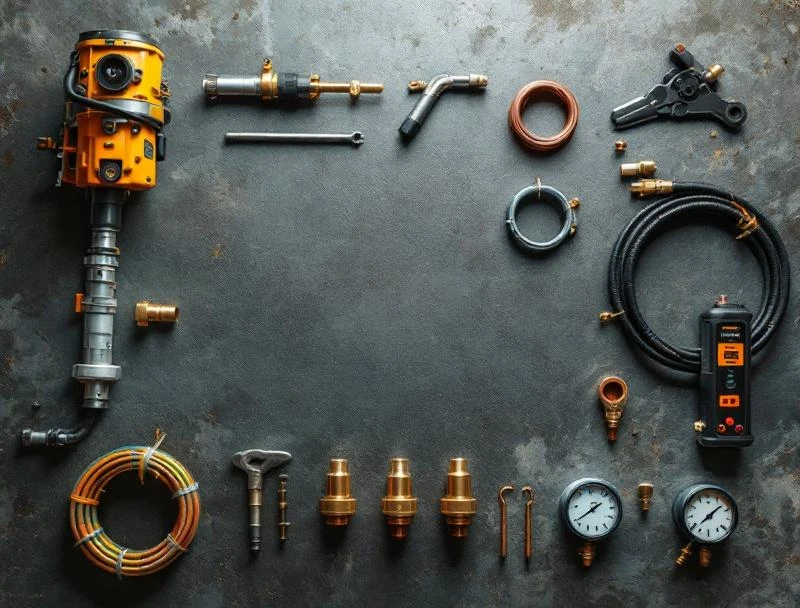
A water line repair Tulsa call covers everything from main service line replacement (meter-to-house) through whole-home repipe, PRV replacement, hose-bib retrofit, and yard leak repair. The scope is broader than any other plumbing category because the supply system spans from the City of Tulsa Water meter at the property edge to every fixture in the home.
The dominant Tulsa water-line failure modes split by housing era. Pre-1960 stock in Cherry Street (74104), Maple Ridge (74114), Pearl District (74120), Owen Park (74127) typically has original galvanized supply at end of life. 1978-1995 polybutylene under 74129 East Tulsa, 74145 Eastland, parts of 74135 Patrick Henry is essentially a known-failure cohort. Post-2000 PEX-era stock in 74012 Broken Arrow, 74008 Bixby, 74037 Jenks, 74055 Owasso sees fewer service-line failures but the 2021 Uri freeze still surfaced damage 5 years later.
The Line From the City Meter to Your Tulsa House
Water service in Tulsa originates from Lake Spavinaw via Spavinaw Creek, with Lake Eucha as managed-flow secondary. Water is processed at Mohawk WTP and A.B. Jewell WTP and distributed through City of Tulsa Water mains in the street. The mainline tap connects to a customer service line via a corporation stop at the main, runs through the city right-of-way to a curb-stop valve at the property line, then into a meter pit on the property.
The meter pit contains the City of Tulsa Water meter — utility-owned. Everything from the meter forward is homeowner-owned, including (in some configurations) the curb stop. The customer service line continues from the meter to the house, typically buried at 18-24 inch depth-of-cover, and enters the home through a foundation penetration.
This split of responsibility is the single most-confused element of water-line service. Spot repairs at the curb-stop transition require coordination of the meter shutoff before any work begins. We handle customer-side; City of Tulsa Water handles meter-side.
Why Water Lines Fail in Tulsa Soil
Tulsa supply pressure typically arrives at the residential meter at 60-80 psi — high enough that any home without a functioning PRV is running fixtures and water heater above the 60 psi residential code preference, accelerating supply-side wear. Water hardness 60-90 mg/L moderately soft from the Lake Spavinaw watershed produces a different scaling regime than hard-water midwest cities.
Failure modes by material: galvanized narrows internally by mineral occlusion, eventually choking flow before outright pipe failure. Type M copper develops pinhole leaks from electrolytic corrosion in mildly aggressive Tulsa water. Polybutylene embrittles from chlorinated water exposure and fails catastrophically at fittings. PEX generally tolerates Tulsa water and soil well; failures are usually fitting-related (expansion fitting failure, dezincification of pre-2005 brass fittings).
Soil movement contributes to service-line failure at the meter-to-house transition. Oklahoma red-clay seasonal cycling stresses the riser at the meter pit. Older brass compression couplings can develop slip failures under cyclical movement.
Polybutylene, Galvanized, and Copper — What’s Under Tulsa Yards
Polybutylene (PB) installed across Oklahoma 1978-1995 before the Cox v. Shell class action is essentially a known-failure cohort. The Shell-Hoechst-DuPont resin and acetal-fitting combination embrittles under chlorinated water exposure. Identify by gray colour (not white PVC, not red/blue PEX) and crimped acetal fittings. Any Tulsa home built or repiped in that window with PB pipe should be considered repipe-when-discovered.
Galvanized iron dominated pre-1960 supply-line construction. Internal mineral occlusion narrows bore by 30-50% over 50-70 years. Pre-1930 Maple Ridge (74114), Cherry Street (74104), Owen Park (74127) typically have galvanized supply at end of life. Pressure complaints are the typical first symptom.
Type M / L copper dominates 1940s-80s construction. Type M is thinner-walled and more susceptible to electrolytic corrosion in mildly aggressive Tulsa water. Brookside (74105), Florence Park (74105), Highland Park (74112) copper supply is now in active pinhole-failure window.
PEX-A (Uponor / Wirsbo) dominates post-2000 construction. Expansion fittings flex with thermal and structural movement. PEX-B with crimp rings is acceptable but PEX-A is preferred for long-term reliability.
Whole-Home Repipe — When Spot Repair Stops Making Sense
Decision threshold for whole-home repipe: any single polybutylene failure (the rest of the system is statistically near-failure), two or more copper pinhole leaks within 24 months (system-wide pinhole pattern emerging), galvanized pressure complaints across multiple fixtures (bore reduction throughout the system), or chronic service calls for supply-side issues.
Repipe scope: install new PEX-A distribution from manifold to each fixture, abandon the old supply lines in place, pressure test the new system, coordinate drywall and finish work for any new chase routing. Typical 1,800-2,400 sf single-story home repipe runs 2-4 days and $5,500-$12,000 depending on fixture count, accessibility, and finish-work scope.
For occupied-during-work scenarios, the homeowner experiences brief water-off periods (typically 2-4 hours) during the cutover and an extended period without certain fixtures during the active work. Many homeowners opt for short-term relocation during the work for comfort.
Pressure Regulators, Curb Stops, and Hose Bibs
Pressure-reducing valves (PRV) installed at the meter or just downstream regulate residential pressure to a safe range (typically 50-65 psi). Tulsa supply pressure arrives at 60-80 psi at the meter, which is above the 60 psi residential preference for fixtures and water heaters. PRV failure produces high-pressure symptoms: hammer noise, T&P drips, premature fixture wear.
Watts N45BM1, Wilkins 600, Honeywell DS06 are dominant residential PRV models. Replacement: shut off cold supply, drain the line, cut out the old PRV, install new with appropriate adapters, set the pressure, and verify with a gauge.
Curb stops are the City of Tulsa shutoff at the property line. Mueller and Ford Meter Box are the dominant brands. Curb-stop replacement requires coordination with City of Tulsa Water for meter shutoff and for AutoCAD-grade access to the curb stop key.
Hose bibs (outdoor faucets) come in standard and frost-free configurations. Woodford Model 17/19 and Prier C-244 are the dominant frost-free residential hose bibs in Tulsa. Frost-free models move the valve seat 6-12 inches inside the warm-side wall to prevent freeze damage.
Locating a Yard Leak Before Digging
Yard leaks announce themselves with wet patches, green grass over dry weeks, soft soil along the lateral path, and unexplained water bill spikes. Acoustic ground-microphone locate narrows excavation to a single pit by detecting the high-frequency hiss of pressurized water escaping through a small leak.
The diagnostic sequence: pressurize the supply at full pressure, walk the lateral path with a ground microphone, listen for leak signature. SubSurface LD-12, Goldak 902B are the dominant residential acoustic detectors. FLIR thermal camera picks up surface-temperature signature of escaping water, particularly useful for hot-side leaks under hard surface.
For ambiguous cases, tracer-gas detection with hydrogen-nitrogen mix definitively confirms leak location. The diagnostic deliverable is a marked surface point with depth estimate, allowing precise excavation.
Acoustic ground-microphone work narrows excavation to a single pit, and yard leak detection in 74063 Sand Springs covers the locate-only deliverable when the customer wants a confirmed pinpoint before committing to repair.
Trenchless Water Service Replacement in Tulsa
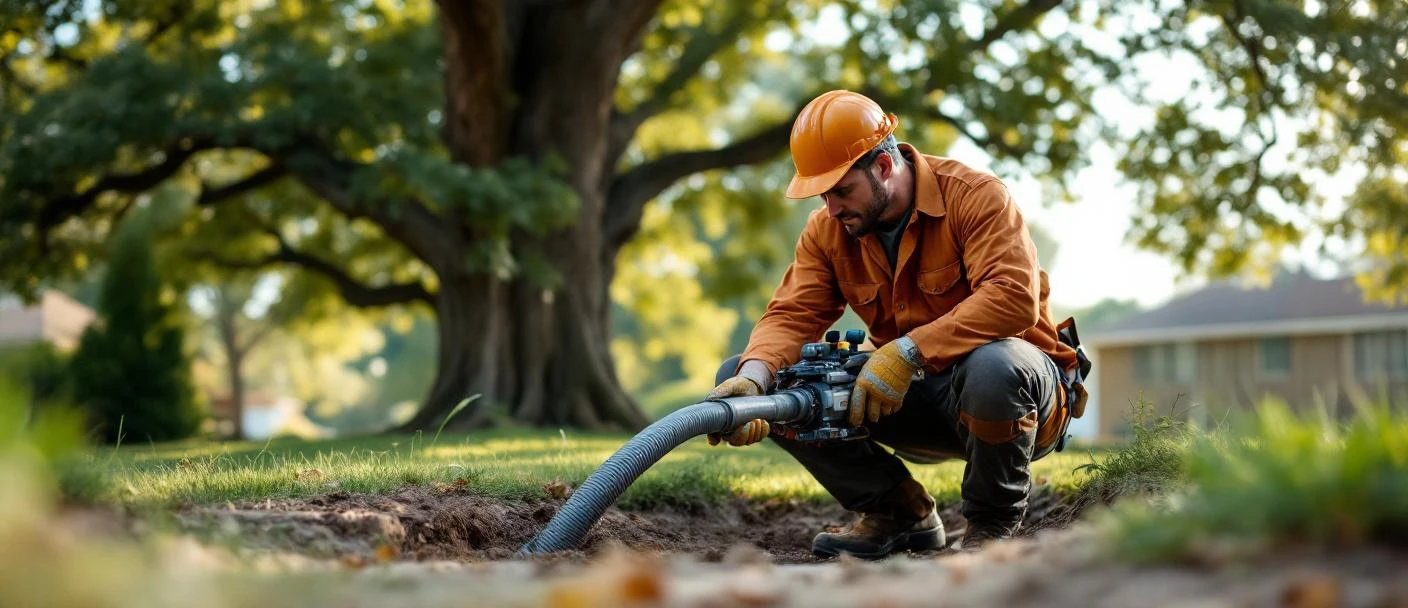
Pneumatic pipe-bursting for water service replacement uses the same equipment as sewer-line bursting — a pneumatic head splits the existing pipe outward while pulling new HDPE replacement pipe behind it. Two small entry pits — one at the meter, one at the house — provide access.
Best for 74104 Cherry Street, 74114 Maple Ridge, 74120 Pearl District, 74127 Owen Park mature streetscape where excavation would damage landscape, driveways, and hardscape. Trenchless service line replacement at 60-80 ft typical lengths runs $3,500-$6,500 in the Tulsa market — narrow margin over open-trench when surface restoration is included.
TT Technologies Grundocrack and HammerHead are the dominant pneumatic systems. The replacement pipe is typically HDPE for buried service-line runs; transition to copper or PEX inside the home.
Permit, Inspection, and Backflow Coordination
Tulsa Codes & Construction Services issues permits for service line replacement and whole-home repipe scope. Suburban authorities (Broken Arrow, Bixby, Jenks, Owasso) each have their own permit thresholds. Spot repair on exposed accessible pipe usually doesn’t require a permit; service line replacement always does.
Backflow preventer installation falls under the City of Tulsa Cross-Connection program. Required for any property with irrigation, fire suppression, boiler, or process-water connections. Watts 909, Febco 825Y, Wilkins 975XL are the dominant residential RPZ assemblies. Annual testing required by City of Tulsa with certified tester.
Main Water Service Line Replacement (Meter to House)
Service line replacement scope: shut off meter (City of Tulsa coordination), cut the line at meter pit and at house entry, replace with new Type K copper or PEX-A, install new service stub at the meter, install new entry stub at the foundation, pressure test, restore service.
Typical Tulsa residential service line is 3/4-inch or 1-inch copper or PEX-A. Depth-of-cover 18-24 inches per code. Tracer wire required for buried PEX or HDPE service to enable future location.
For trenchless scope, two small entry pits avoid full excavation of the lateral path. For open-trench scope, the lateral path is excavated and shored per OSHA requirements.
Service-line failure at the slab penetration point is its own scope, and Tulsa slab leak repair covers the under-slab segment that yard-side excavation doesn’t reach.
Polybutylene Whole-Home Repipe (1978-1995 Era)
Polybutylene installations in Oklahoma between 1978 and 1995 are essentially a known-failure cohort. The Cox v. Shell class action settled in 1995. Affected Tulsa neighborhoods include parts of 74129 Sequoyah, 74145 Kensington, 74135 Patrick Henry.
Repipe scope: new PEX-A distribution from manifold to each fixture, abandoning the old PB lines in place, pressure testing the new system, drywall coordination for any new chase routing. Typical 1,800-2,400 sf home runs $5,500-$11,000.
Polybutylene under 74129 East Tulsa and 74145 Eastland slabs combines two failure modes — pipe embrittlement plus slab penetration without sleeve — which is why these zips show disproportionate slab-leak repair-to-repipe escalation.
Galvanized-to-Copper-or-PEX Whole-Home Repipe
Galvanized supply repipe scope is similar to polybutylene repipe but with different driving symptoms. Galvanized failures present as pressure complaints rather than catastrophic fitting failures — the bore narrows progressively and fixtures lose flow over years rather than failing suddenly.
Pre-1930 Tulsa neighborhoods (74103, 74104, 74114, 74120, 74127) commonly have galvanized supply at end of life. Repipe to PEX-A restores hydraulic capacity that no spot repair can recover.
Trenchless Water Service Replacement
Pneumatic pipe-bursting uses the same approach as sewer-line bursting. Best applications: meter-to-house service replacement in mature streetscape, driveway-cluttered Tulsa lots, landscape preservation priorities.
Cost is competitive with open-trench once driveway and landscape restoration is priced in. For yards with simple grass and minimal landscape, open-trench may be cheaper. For mature trees, hardscape, or driveway crossings, trenchless wins.
Sewer and water service often run within feet of each other in pre-1960 Tulsa right-of-way, and Tulsa sewer line repair scheduling alongside the same dig saves the second mobilization.
Yard Water Line Leak Locate and Spot Repair
Acoustic locate narrows excavation to a single pit. Standard 1-2 hour locate session identifies the leak point with depth estimate. Spot repair through a small excavation, install new section with SharkBite or compression couplings (for emergency repair) or soldered/PEX expansion (for permanent repair), pressure test, and backfill.
For yard leaks at single isolated points on otherwise sound lines, spot repair runs $700-$1,800 in the Tulsa market. For yard leaks on end-of-life service lines (galvanized, polybutylene), full replacement is more economical.
Pressure Reducing Valve (PRV) Replacement
PRV failure produces high-pressure symptoms throughout the home: hammer noise, T&P drips at water heater, premature fixture wear, and supply-side leaks (PRV failure puts higher pressure on the entire system, accelerating any weak point).
Replacement: shut off cold supply, drain the line, cut out the old PRV, install new with appropriate adapters, set the pressure to 60-65 psi, verify with a pressure gauge at a hose-bib test point, restore service.
Watts N45BM1, Wilkins 600, Honeywell DS06 are the dominant residential PRV models. Total time 1.5-2 hours. PRV replacement is required by code on closed-system water heaters (any home with a PRV at the meter).
Curb Stop Repair / Replacement
Curb stops sit at the property line and are the city-side shutoff for the customer service line. Mueller and Ford brands dominate Tulsa installations. Curb-stop key is required to operate the valve.
Replacement requires coordination with City of Tulsa Water for meter shutoff. Excavation at the curb stop, removal of old valve, installation of new ball-valve-style curb stop (modern preference), and curb-box adjustment for proper key access.
Common bundled service when service line replacement reveals a seized curb stop that won’t operate. We handle the customer-side coordination with City of Tulsa Water.
Hose Bib Replacement and Freeze Repair
Frost-free hose bib replacement (Woodford Model 17/19, Prier C-244) is the standard upgrade after any freeze-burst event on a non-frost-free hose bib. The replacement: open the wall to access the bib body, remove the old assembly, install the new frost-free with appropriate stem length (6-12 inches depending on wall configuration), connect to supply with sweat or PEX expansion, install proper through-wall sealant on the exterior trim, restore water and test.
Anti-siphon vacuum breaker is required by code on every hose-bib replacement. Modern frost-free designs typically integrate the vacuum breaker into the bib body.
Whole-Home Pressure Diagnosis
Pressure diagnosis sequence: gauge measurement at hose-bib test point with all fixtures off (static pressure), gauge measurement with full-flow demand from a single fixture (dynamic pressure), pressure reading at multiple points to identify any drop along the supply path.
Typical diagnostic: 60-80 psi at the meter (City of Tulsa standard), 50-65 psi after PRV (if present), uniform reading at each fixture supply point. Drops along the path indicate restriction (galvanized scaling, partially closed shutoff, or sediment in supply-side strainer).
Frozen Burst Water Line in Yard
Yard service lines at shallow depth-of-cover (less than 18 inches) are vulnerable to freeze damage during Uri-class events. The Tulsa code requires 18-24 inch cover; pre-code installs may be shallower.
Diagnosis: pressure loss at the meter with all fixtures off, no interior leak found, wet patch in yard above the lateral path. Repair: locate the failure point with acoustic, excavate, cut out failed section, install new with SharkBite for emergency or proper PEX/copper for permanent, pressure test, and backfill with appropriate cover for future freeze protection.
Yard-side service-line splits after Uri-class events show as house-side pressure loss with no interior leak, and burst pipe repair Tulsa scope picks up the service-line freeze rupture as a single dispatch.
Backflow Preventer (RPZ / Double Check)
Backflow preventer (RPZ - Reduced Pressure Zone) and DCVA (Double Check Valve Assembly) installations protect potable water from contamination via cross-connection with non-potable systems. City of Tulsa Cross-Connection program requires RPZ for irrigation, fire suppression, boiler systems.
Watts 909, Febco 825Y, Wilkins 975XL are dominant residential and small-commercial RPZ assemblies. Annual testing required by City of Tulsa with certified tester credential. Lapsed assemblies can drive utility shutoff notices.
Water Meter Coupling and Service Stub Repair
Meter-side leaks at the customer-side stub require coordination with City of Tulsa Water. The utility owns the meter; the customer owns the stub from the meter forward. Leak at the customer-side compression coupling is repair scope on the customer side; leak at the meter itself is utility scope.
Standard residential meter coupling failure: corroded brass compression coupling, slip failure under cyclical movement, or threads stripped from improper torque. Replacement requires shutting off at the curb stop, draining the line, replacing the coupling with new compression fitting, pressure test, and restore service.
Tulsa-Specific Factors That Shape Water Line Repair
Lake Spavinaw / Lake Eucha source water is moderately soft (60-90 mg/L) and lightly chloraminated, creating a different corrosion regime than hard-water midwest cities. Tulsa supply pressure 60-80 psi at the meter drives PRV demand throughout the metro. Tulsa frost line ~12 inches with 18-24 inch depth-of-cover code minimum — adequate for normal years, inadequate for Uri-class events.
Pre-1930 Tulsa galvanized supply is universally end-of-life. Polybutylene era 1978-1995 is a known-failure cohort. Post-2000 PEX construction sees fewer service-line failures but the 2021 Uri event surfaced damage 5 years later.
74063 Sand Springs, 74066 Sapulpa, 74107 West Tulsa river-side soil drives different yard leak patterns than dry-side zips. The Arkansas River flood plain proximity affects soil moisture cycling.
Permit, Inspection, and Backflow Coordination
Tulsa Codes & Construction Services issues permits for service line replacement and whole-home repipe. Suburban authorities (Broken Arrow, Bixby, Jenks, Owasso) have their own permit processes. Oklahoma CIB licensing applies to all major water-line work; verify contractor at cib.ok.gov.
City of Tulsa Cross-Connection program governs backflow preventer installations and annual testing requirements. City of Tulsa Water customer-service line handles meter-side coordination, billing inquiries, and leak-detection assistance.
Oklahoma Plumbing Context for Water Line Work
Oklahoma Plumbing Code (UPC 2018 + state amendments) governs material selection, depth-of-cover requirements, joint sealing, and code-compliant pipe support. Oklahoma Construction Industries Board licensing applies to all major water-line work. Oklahoma Plumbing License Law Title 59 § 1001 governs licensure.
For service-line scope, the customer/utility demarcation at the City of Tulsa meter is the critical regulatory boundary. We work the customer side; the city handles the utility side. Coordination between the two is part of any service-line replacement scope.
Service-line failures in winter rarely wait for daylight, and our Emergency Plumber Tulsa dispatch handles meter-side coordination and yard-line work outside normal hours.