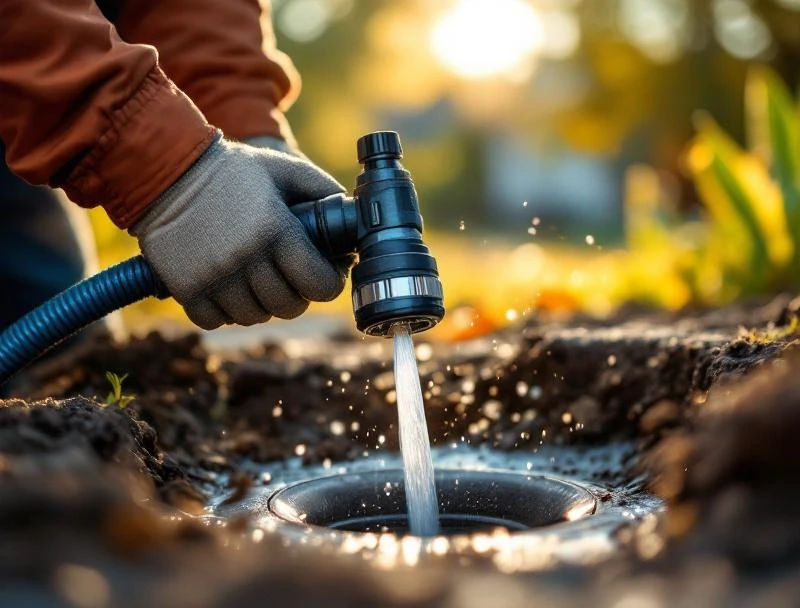
A drain cleaning Tulsa call is the single highest-volume category in plumbing service across the metro. Every Tulsa home has dozens of drain points — kitchen, bathroom, laundry, floor — and any one of them can clog independently, while a main-line obstruction shuts down the entire household at once. This page covers branch-drain clearing, main-line snaking and hydrojetting, camera inspection, and the storm-vs-sanitary code education that distinguishes professional drain work from chemical-cleaner shortcuts.
Tulsa’s drain landscape splits along housing era. Pre-1960 cast iron in Cherry Street (74104), Maple Ridge (74114), Owen Park (74127), and Brookside (74105) is now scaled and constricted — bore reduction of 30-50% before any visible clog forms. PEX and PVC drain construction post-1990 in 74012 Broken Arrow, 74008 Bixby, 74055 Owasso, and 74037 Jenks rarely needs hydrojetting; debris-only clogs respond well to mechanical snaking. Knowing what’s behind the cleanout cap before we open it shapes the repair scope and the cost.
What Drain Cleaning Costs Across Tulsa Service Calls
Standard branch-drain cabling runs $150-$280 — kitchen sink, bathtub, single bathroom drain. Toilet auger service runs $180-$300. Main-line snaking via an accessible cleanout runs $250-$450 in the Tulsa market. If the home doesn’t have an accessible cleanout (common in pre-1960 stock), installing one as part of the call adds $200-$450, bringing combined service to $450-$900.
Hydrojetting main lines starts at $450 for residential and runs to $1,200 for restaurant-grade grease lines that need extended jetting time and rotating warthog nozzles. Sewer camera inspection runs $250-$450 and is often credited toward the cost of any subsequent repair work — making the diagnostic essentially free when followed by a repair scope.
Garbage disposal repair runs $180-$320 for jam-clearing and leaking-flange repair. Disposal replacement (Badger 5 to Evolution Compact range) runs $350-$650 installed including the new flange, splash guard, and supply connections.
Slow-Drain Symptoms That Point to Bigger Problems
Slow drain on a single fixture usually means a localised obstruction in the trap or branch line. Slow drain on multiple fixtures simultaneously points to main-line obstruction further downstream. Sewer odor escaping from a floor drain almost always means a dry trap rather than a clog — the trap primer has stopped working and the water seal has evaporated.
Recurring kitchen-line clogs typically mean grease-and-food-fat accumulation rather than a single foreign object. Each cabling clears the immediate obstruction but leaves the grease film on the pipe walls, which catches the next wave of debris. Hydrojetting cleans the pipe walls fully and extends service intervals by years.
Bathroom drains that gurgle when toilets flush, or fixtures that bubble during washing-machine drain cycles, signal partial main-line obstruction. The waste stream from one fixture is restricted enough that adjacent drains pull air from the wrong direction. This is a higher-priority clearing call than a single slow fixture.
How Our Plumbers Clear a Drain Without Damaging the Pipe
Diagnosis starts with line size and accessibility. 1-1/2” branch drains (sink, lavatory) take a smaller cable and gentler cutter than 3” or 4” mains. Pre-1960 cast iron mains require softer cutter heads to avoid chipping the scaled internal surface; modern PVC mains tolerate aggressive cutters and rotating heads.
The cabling sequence: identify the closest accessible cleanout, match cable length to estimated obstruction distance, select cutter head appropriate to the suspected obstruction (smoothing head for grease, root-cutter for tree roots, retrieval head for foreign objects), and run the drum machine with controlled feed. Reverse cable rotation if the cable binds — forcing through a bind risks cracking older pipe materials.
For hydrojetting, the procedure is similar but with high-pressure water rather than mechanical cable. US Jetting and Harben rigs at 1500-4000 psi for residential, 4000-7000 psi for commercial. Rotating warthog nozzles for grease, fixed nozzles for general flushing, root-cutter nozzles for invasion. Flush water runs continuously during the operation to evacuate dislodged debris.
Camera inspection follows on recurring problems to verify pipe condition. RIDGID SeeSnake push-camera systems with NaviTrack sonde locator allow precise marking of any defect for follow-up repair. We provide recorded video of significant findings for homeowner reference and insurance documentation.
Why Hydrojetting Is Different From a Mechanical Snake
A mechanical snake (drum cable machine) cuts a hole through the obstruction and clears the immediate flow path. It doesn’t clean the pipe walls — grease, scale, and biofilm remain coated on the interior surface. The next wave of debris clings to that surface, and the clog typically returns within months on a grease-heavy line.
Hydrojetting at 1500-4000 psi flushes the entire interior surface of the pipe. The rotating jet head cuts the obstruction and simultaneously scrubs the pipe walls clean. For a heavily grease-coated kitchen line or a root-invaded sewer lateral, hydrojetting extends the service interval from months (with cabling) to years.
The trade-off: hydrojetting requires a relatively intact pipe to work safely. Cracked clay tile, severely scaled cast iron, or polybutylene drain laterals can be damaged by full-pressure jetting. Camera inspection first, then jetting at appropriate pressure for the pipe condition, is the standard professional sequence.
How Tulsa’s Restaurant Corridor Affects Local Drain Systems
The restaurant corridors on Cherry Street (74104), Brookside (74105), and the Blue Dome District (74103) have specific commercial grease-trap requirements; residential hydrojetting of an apartment above a restaurant requires coordination on grease capture. Mixed-use buildings in these corridors often have shared sanitary stacks where a restaurant kitchen below feeds into the same main as residential units above.
Pre-1960 Tulsa neighborhoods with mature tree canopy — particularly Maple Ridge (74114) silver maples, Brookside (74105) post oaks, and Cherry Street (74104) elms — produce some of the highest residential root-invasion rates in the metro. Roots find their way through hairline joint cracks in clay-tile and cast-iron laterals and grow toward the moisture inside.
Modern subdivisions with PVC drain construction (74012 Broken Arrow, 74008 Bixby, 74037 Jenks, 74055 Owasso) rarely face root invasion because PVC joints don’t telegraph moisture the same way clay tile does. Drain problems in these neighborhoods are usually debris-only and respond well to mechanical snaking.
City of Tulsa Wastewater Rules and the Storm-vs-Sanitary Boundary
City of Tulsa Wastewater operates two main treatment plants: Northside WWTP and Southside WWTP. The sanitary sewer system handles only sanitary waste — toilets, sinks, showers, washing machines, dishwashers. Storm water (rainfall, sump-pump discharge, downspout runoff) belongs in the separate storm drain system.
City of Tulsa Wastewater prohibits sump-pump and roof-drain discharge to the sanitary sewer system. Violations trigger inflow-and-infiltration surcharges to the property and can affect property records. Sumps should discharge to daylight in the yard, to a storm drain catch basin, or to a French drain system. Downspouts should connect to underground drainage that terminates at daylight or at the storm system.
Air-admittance valves (AAVs) are restricted under Oklahoma’s UPC adoption in many residential applications — proper through-roof venting is required for new work, an issue we often catch on snake calls when an AAV failure is misdiagnosed as a clog.
Drain Snake Tools That Belong in a Plumber’s Hands
Professional drum machines (RIDGID K-400 for branch lines, RIDGID K-750 for mains, RIDGID K-1500 for heavy main-line work, Spartan Tool 100/300/1065 series) handle Tulsa’s range of drain sizes and obstruction types. Cutter head selection matches the obstruction: cutting heads for fresh roots, retrieval heads for foreign objects, smoothing heads for general flush.
Hydrojetters from US Jetting, Harben, and Sewer Equipment Company in residential 1500-4000 psi class and commercial 4000-7000 psi class. Rotating warthog nozzles for grease, fixed nozzles for general flush, root-cutting nozzles for invasion. RIDGID SeeSnake camera systems and RIDGID NaviTrack II sonde locators for inspection and marking.
Hardware-store snakes are appropriate for accessible single-fixture clogs only. The cable length, motor power, and cutter selection on rental units don’t match professional needs — and the risk of cracking an older cast iron or polybutylene line with aggressive cabling is real.
When a Slow Drain Means Stop Using Water Now
Sewage backing up onto living-area floors is a stop-immediately situation. Continued water use will worsen the backup, drive sewage further into the home, and increase contamination scope. Shut off water at the main and call us. We coach stabilisation while a truck rolls.
For multiple-fixture slow drains without active backup, reducing water use until we arrive prevents the situation from escalating. Run only essential fixtures (one toilet, no showers, no washing machine, no dishwasher). Don’t pour anything down drains — every gallon adds to the backup pressure.
For a single slow fixture without other symptoms, normal use is fine until we arrive. The branch drain affects only that fixture and won’t escalate to whole-house backup.
Kitchen Sink Drain Snaking and Grease-Clog Clearing
Kitchen drain clogs are the highest-volume single drain type. The combination of cooking grease, food particles, and dish soap creates a viscous coating on the pipe interior that progressively narrows the bore until flow becomes inadequate. Disposal-side kitchens (with garbage disposals) accumulate at a faster rate than non-disposal sinks because the disposal grinds food into smaller particles that bind more tightly to the grease film.
Standard 1-1/2” kitchen branch drains take a 3/8” or 1/2” cable from a drum machine. The cable feeds through the trap arm and into the wall to clear the typical obstruction zone. For severe grease problems, hydrojetting the kitchen line at 1500-2500 psi removes the grease coating fully and extends service intervals by years rather than months.
Common Tulsa restaurant-corridor commercial calls involve daily kitchen-line maintenance for grease-heavy operations. Restaurant grease traps must be sized and serviced per local code; residential disposal-side kitchens follow the same general principles at smaller scale.
Bathtub Drain Cleaning
Bathtub drains accumulate hair, soap scum, and body oils. The clog typically forms at the trap or just downstream — the hair traps the scum and the scum traps more hair. Drum auger cabling clears most bathtub clogs in 30-45 minutes.
Access points: through the overflow drain (most common), through the drain itself by removing the strainer, or through the trap below if accessible. Linear drains (becoming common in newer Tulsa bathroom remodels) require different access technique because the trap configuration differs from traditional drains.
Toilet Auger Service
Toilet clogs come from foreign objects (toys, hair clips, sanitary products) or excessive paper accumulation. A closet auger (toilet auger) — different from a drain snake — has a curved guide that protects the porcelain from cable damage. Standard residential closet augers handle most clogs in 15-30 minutes.
If the closet auger doesn’t reach the obstruction, the issue is usually downstream of the toilet itself — in the branch drain or main stack. That shifts the work into drain-cleaning scope rather than toilet repair. We pull the toilet to access the flange and run a regular drain cable through the floor flange when needed.
Floor Drain Cleaning and Trap Primer Service
Basement floor drains in pre-1990 Tulsa homes commonly have failed trap primers. The primer is a small valve in the supply line that periodically sends water to the floor drain trap, keeping the seal intact. When the primer fails or is plugged with mineral deposit, the trap dries and sewer gas escapes.
Diagnosis: pour a quart of water into the floor drain and check if odor returns. If water restores the seal and odor disappears, the trap is fine and the primer needs replacement. Mini-Vent, PR-500, and Sioux Chief primer valves are common Tulsa replacements. If the floor drain is actively clogged (water doesn’t drain), cabling clears the line.
Main Line Snaking via Cleanout
Main-line work uses heavier drum machines (RIDGID K-1500 or equivalent) with longer cables (75-100 feet) and 3” or 4” cutter heads. The cleanout access point determines the work scope: an accessible exterior cleanout near the property line is ideal; a roof-vent access requires lift equipment; an interior basement cleanout works but has containment considerations.
Cleanout installation as part of the call is common in pre-1960 homes that lack proper access. We install a two-way cleanout at the property edge that allows future cabling toward the house or toward the street. Cherne and Oatey cleanout fittings are the dominant Tulsa standards.
Recurring main-line backups within 30-60 days of a successful clear typically signal root, belly, or partial collapse, and sewer line repair in Tulsa covers the camera locate, sonde marking, and trenchless replacement scope.
Garbage Disposal Repair and Replacement
Disposal jams clear with the bottom-side Allen wrench access — every modern disposal has a hex socket on the bottom for jam clearing. Insert the wrench, work the rotor back and forth until it spins freely, then press the reset button on the bottom of the unit.
For motors that hum but don’t spin, the start capacitor has typically failed. Replacement involves removing the disposal, opening the motor housing, and replacing the capacitor — typically not cost-effective for older units. Disposal replacement (Badger 5, Badger 500, Evolution Compact, Evolution Excel range) runs $350-$650 installed including new flange, splash guard, and supply connections.
Toilet Drain Cleaning Past the Trap
When a closet auger doesn’t reach the obstruction, the work shifts to drain-cleaning scope. Pull the toilet, access the flange, and run a regular drain cable through the floor flange. Common obstructions include broken wax-ring debris, foreign objects past the toilet trap, or partial flange-to-drain misalignment.
Before reinstalling the toilet, inspect the flange — if it’s broken, set lower than the finished floor, or otherwise compromised, repair scope includes flange replacement or extension ring installation.
Toilet drains that clog repeatedly with normal use often have a partial wax-ring or flange-seat failure rather than a line obstruction, and Tulsa toilet repair scope covers the bowl-pull and reset that cabling can’t reach.
Shower Drain Repair
Shower drains in modern Tulsa construction use either traditional center drains (with weep holes for tile-shower installations) or linear/channel drains (becoming common in remodels). Hair clogs are the dominant failure mode in both. Drum auger cabling clears most clogs through the drain itself; severe clogs require trap access from below if there’s a ceiling cavity beneath.
Linear drains in tile showers occasionally develop seal failures at the trough connection — that’s a tile-and-membrane repair scope rather than drain cleaning, but we coordinate with tile contractors when the issue presents.
Outdoor and Yard Drain Cleaning
French drains, NDS catch basins, and downspout-to-storm-drain runs all eventually clog with sediment and root growth. Tulsa storm season (May-June convective systems) drives concentrated demand on yard drainage; failures show up as standing water during heavy rain.
Camera inspection of yard drains identifies the obstruction location. Mechanical snaking through accessible cleanouts clears most obstructions. Hydrojetting is occasionally appropriate but pressure must match the pipe material — corrugated HDPE drain tile (common in newer installs) tolerates jetting at moderate pressure; older clay or concrete drain tile may not.
Backups that crack a drain line under the slab show up after the cabling is done, and drain leak detection runs camera, smoke-test, and moisture-mapping to find the break that the backup created.
Storm vs Sanitary Drain — City of Tulsa Wastewater Compliance
The fundamental rule: storm water belongs in the storm drain system; sanitary waste belongs in the sanitary sewer system. They are separate systems with different sizing, different treatment paths, and different regulations. Mixing them — discharging sumps to sanitary, or routing roof drains into floor-drain stacks — is prohibited and triggers I&I surcharges.
City of Tulsa Wastewater enforces this through field inspection and through utility-rate analysis (anomalous wet-weather flow patterns flag potential illicit connections). Discharge from sumps or downspouts to the sanitary system can be detected and traced. The remediation: redirect to legal discharge (daylight, storm system, French drain), document the change, and request review by City of Tulsa Wastewater.
This is the kind of education we provide on every drain call where we encounter the issue. Most Tulsa homeowners don’t realize their sump pump is illegally tied to sanitary; the original installer sometimes did it incorrectly decades ago and it’s been quietly contributing to the wastewater treatment load ever since.
Drain-tile clogs at the pit entry mimic sump-pump failure with no actual pump fault, and sump pump repair in 74063 Sand Springs scope covers the pit-side drain-tile flush and pump diagnostic together.
Tulsa-Specific Factors That Shape Drain Cleaning
Tulsa’s housing-era split shapes every drain call. Pre-1930 mansion stock in Maple Ridge (74114), Cherry Street (74104), Owen Park (74127) has 4-inch cast iron mains with bell-and-spigot joints sealed with cement mortar — joint failure is essentially universal at 80+ years and creates predictable root-invasion patterns. 1940s-60s Brookside (74105) and Highland Park (74112) have cast iron with offset joints from settlement.
Modern subdivisions with PVC drains (74012 Broken Arrow, 74008 Bixby, 74037 Jenks, 74055 Owasso) rarely face root invasion. Failures here are debris-only and respond well to mechanical snaking. Cast iron stack-and-branch repairs in pre-1960 stock often involve significant access work (drywall, finish floor) compared to modern PVC repairs.
Polybutylene drain laterals in some 1978-1995 Tulsa installations are extremely brittle — heavy snaking has been known to crack them, requiring camera inspection first.
Oklahoma Plumbing Context for Drain Cleaning
Drain cleaning scope in Oklahoma generally falls below the Oklahoma CIB licensing threshold for residential work — anyone can clean a drain. But work that involves pipe replacement, code-compliant cleanout installation, or main-line work tied to permit scope does require licensed plumbing contractor credentials.
Tulsa Codes & Construction Services issues permits for drain-line replacement and cleanout installation. The Oklahoma Plumbing Code (UPC 2018) governs minimum pipe slope (1/4” per foot residential), cleanout placement requirements, vent stack sizing, and trap arm length.
For chronic drain problems that point to pipe replacement, the work crosses into sewer-line repair territory — different scope, different equipment, different permit considerations.
Sewer backups never happen at convenient hours, which is why our Emergency Plumber Tulsa dispatch keeps drain trucks rolling overnight and through every weekend across the metro.