A gas line repair Tulsa call carries the highest stakes in the plumbing service category — natural gas leaks present immediate fire and explosion risk, and the line of responsibility between Oklahoma Natural Gas (ONG) and the homeowner is one of the most-confused boundaries in residential utility service. This page covers leak detection, CSST and black-iron repair, pressure testing, appliance gas connections, and the regulatory landscape that governs every gas-line scope.
ONG is the gas distribution utility for greater Tulsa as a ONE Gas subsidiary headquartered in Tulsa. The proximity matters: ONG emergency response in the metro is generally fast, but homeowner-side leaks still need a licensed plumber, not ONG. Oklahoma Plumbing License Law Title 59 § 1001 reserves natural gas work to licensed plumbers — verify contractor credentials at cib.ok.gov before authorizing any gas work.
When You Smell Gas in Your Tulsa Home
The first move on any gas odor is evacuation. Don’t operate light switches, garage doors, or anything that could spark. Once outside, call ONG’s emergency line — they dispatch utility staff to shut the meter, which isolates the entire customer-side gas system. Then call us for repair.
Natural gas in Tulsa is odorized with mercaptan to a detectable threshold of about 1/5 the lower flammability limit. Strong odor means you’re well past the safe leak threshold. Faint odor at a single appliance might be a pilot-out condition or a slow joint leak; whole-house odor is a high-volume leak that needs immediate utility response.
ONG’s emergency line is staffed 24/7. Their response is fast in the Tulsa metro because they’re locally headquartered. The customer-side repair after the meter is shut waits for our network.
How Tulsa Gas Lines Are Built and Where They Fail
Tulsa gas distribution comes through ONG mainlines in the street to a meter at the property edge. The meter is ONG-owned. From the meter, the customer-side line runs underground to the house — typically yellow polyethylene (PE) gas service pipe with tracer wire — then transitions to black iron or CSST inside the home. Pre-1995 Tulsa construction dominantly uses black iron pipe (schedule 40); post-1995 construction dominantly uses CSST (Corrugated Stainless Steel Tubing) with manufacturers including TracPipe, Gastite, HOME-FLEX, and WARDFlex.
Failure modes split by material. Black iron fails at threaded joints (sealant breakdown, settlement stress, or thread deterioration) and at corrosion points where the pipe contacts moisture. CSST fails from lightning-induced perforation (the corrugated stainless wall is thin and lightning energy can pinhole it) and occasionally at fittings (improper torque or AutoFlare seal failure). PE gas service fails at mechanical damage (digging strikes, root impingement) and at fittings.
Pressure Testing the Right Way — and Why ONG Will Reject the Wrong Way
The Oklahoma residential gas pressure test specification is typically 10 psi held for 15 minutes with no detectable drop on a properly calibrated gauge. Test is performed before backfill on buried lines and before drywall on rough-in work.
The procedure: isolate the test section by closing all appliance shutoffs (or removing appliances), pressurize the line through a test plug to 10 psi, attach a calibrated U-tube manometer or digital manometer (Bacharach, Testo), and watch the gauge for 15 minutes. Any measurable drop indicates a leak somewhere in the test section.
Common failure mode: pressure dropping over the test period traces to a single missed joint. The diagnostic sequence is then bubble-test solution (snoop) on every joint to find the actively leaking connection. Alternatively, CGI (combustible gas indicator) sweeping along the line picks up methane escape at the leak point.
ONG will reject pressure tests that don’t meet the 10 psi / 15 minute standard, or tests performed without proper documentation. Permit and inspection through Tulsa Codes & Construction Services requires test documentation as part of the inspection package.
CSST vs Black Iron in Tulsa Construction
Pre-1995 Tulsa construction (74103 Downtown, 74104 Cherry Street, 74114 Maple Ridge) is dominantly black iron with threaded joints. Settlement-driven joint stress over decades is the recurring failure pattern. Black iron fitting repair is straightforward — cut out the failed section, install new threaded pipe and fittings with gas-rated pipe dope (RectorSeal No. 5) or yellow Teflon tape.
Post-1995 Tulsa construction (74012 Broken Arrow, 74008 Bixby, 74055 Owasso, 74037 Jenks) is dominantly CSST. The yellow corrugated tubing routes more flexibly than black iron and installs faster. CSST became code-compliant in Oklahoma after the bonding requirement was added — every CSST install in Tulsa post-amendment must have a #6 AWG bonding jumper to the grounding electrode system.
CSST manufacturers: TracPipe (Omega Flex), Gastite (Titeflex), HOME-FLEX, WARDFlex, ProFlex. AutoFlare and XR3 fitting systems are the brand-specific connection methods. Each requires brand-specific tools and torque specifications. Fitting replacement requires the brand-matching tool kit.
Coordinating Repairs With Oklahoma Natural Gas
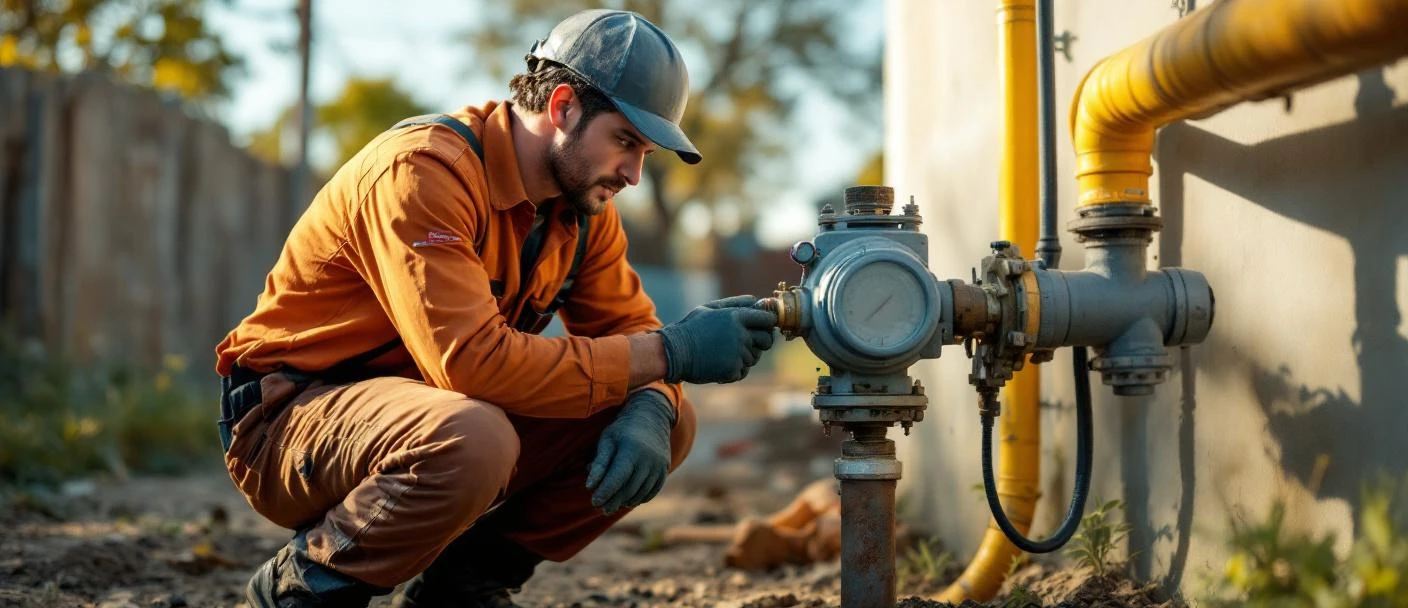
ONG owns and repairs everything upstream of the meter. The customer owns everything from the meter forward. This boundary is the single most-confused element of gas-line service in Tulsa.
For active leaks at or upstream of the meter, ONG dispatches utility crew. For active leaks customer-side, ONG can shut the meter (isolating the entire customer side) but won’t repair the customer line. Our network handles customer-side repair after ONG isolation.
Meter upsize requests for high-demand appliances (tankless heaters, generators) go through ONG with their scheduling timeline. We coordinate the meter-upgrade request as part of project scope — typical timeline is 2-4 weeks from request to upgraded meter, depending on ONG capacity.
Appliance Connections — Range, Dryer, Water Heater, Generator
Range and cooktop gas hookups use AGA-rated flex connector with female pipe thread, sediment trap, and full-port ball valve at the appliance. Sediment trap is required by code on every gas appliance to catch debris before it reaches the gas valve. Standard residential range hookup runs $200-$400 in the Tulsa market.
Dryer gas hookup is similar in scope to range hookup — flex connector, sediment trap, ball valve. Vent termination must be separate from the gas line and code-compliant for moisture and lint exhaust. $200-$350 typical.
Water heater gas hookup is part of every water heater installation. Sediment trap, full-port ball valve, and pressure-test verification are standard. Tankless gas line sizing is the most common upsize scope — see tankless section below.
Whole-house generator (Generac, Kohler RES, Cummins QuietConnect) typically demands 200,000-300,000 BTU/hr at 26 kW class. New 1-inch black iron or CSST run from meter to generator location with appropriate sediment trap and shutoff. Often forces meter upsize coordination with ONG.
Permitting and Inspection for Tulsa Gas Work
Tulsa Codes & Construction Services issues permits for gas line work inside city limits. Suburban authorities (Broken Arrow, Bixby, Jenks, Owasso) each have their own permit processes. Permit triggers AHJ inspection — typically scheduled within 1-3 business days of permit issuance.
The inspector verifies pressure test results, fitting types, code-compliant sealant, sediment trap installation, shutoff valve location, and CSST bonding (where applicable). Failed inspections require remediation and re-inspection before the line is approved for service.
For new construction or major remodels, gas line work integrates with overall plumbing and mechanical permit scope. For repair-only scope, the gas permit is standalone.
Soil Movement, Settlement, and Underground Gas Line Failure
Oklahoma red-clay expansive soil affects buried gas service lines through differential movement at the meter-to-house transition. Yellow polyethylene PE gas pipe is flexible and tolerates moderate soil movement; black iron transitions at risers are more rigid and stress-fatigue at the joint over decades.
Buried gas line damage from yard digging is the other recurring failure mode. PE is invisible to standard metal-detector locators without the tracer wire. Always call before you dig (Oklahoma’s 811 service) before any yard excavation. Discovered damage requires emergency response — gas escape from a punctured PE line creates immediate evacuation scope.
Natural Gas Leak Detection
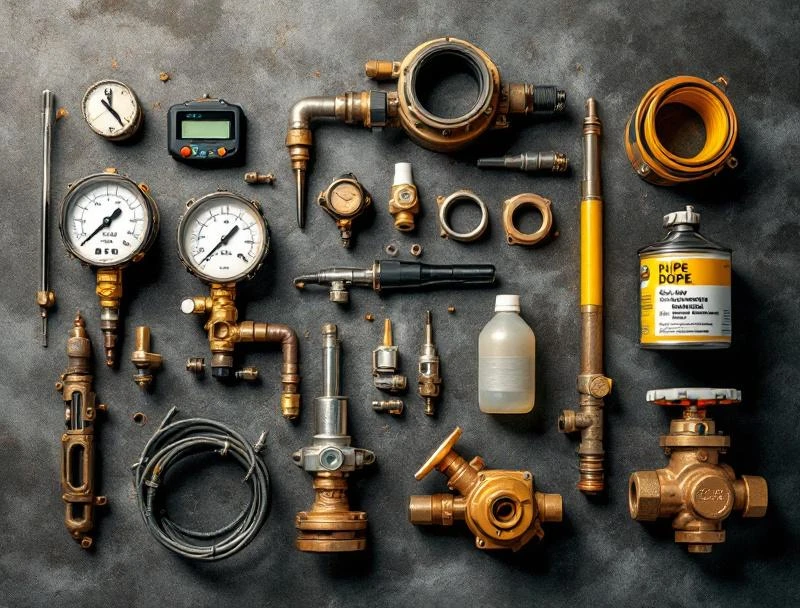
The diagnostic sequence: combustible gas indicator (CGI / methane sniffer) sweep along the suspected gas run, bubble-test solution on individual joints, pressure-decay test on isolated sections, and identification of leak point. Sensit HXG-3 is the dominant CGI tool; bubble solution from any plumbing supply house works for joint testing.
Mercaptan odorant diffuses through walls and confuses point-of-leak diagnosis — homeowners often think the leak is right where they smell it most strongly, but the actual leak point may be 10-20 feet away with mercaptan migrating through wall cavities. CGI sweeping along the full run identifies the actual escape point.
For exterior buried gas lines, soap-bubble visualization at risers and at joints during pressure-charge testing identifies above-ground leak points. Buried-line leaks below ground require excavation at the suspected point.
Mercaptan diffuses through walls and confuses point-of-leak diagnosis, and Tulsa leak detection adds combustible-gas-indicator sweeping along the full run before any joint gets opened.
CSST Flexible Gas Line Repair
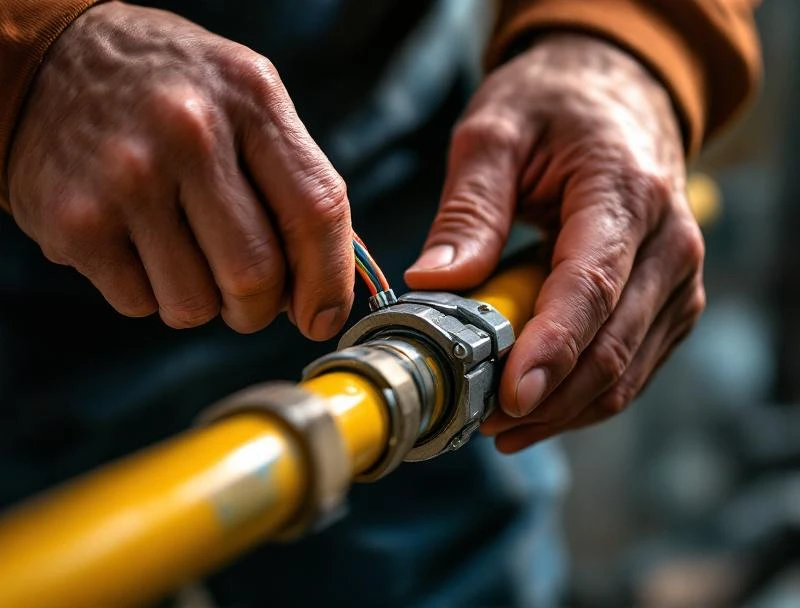
CSST repair: shut off gas at the meter (or at the upstream sectional shutoff), cut out the failed section with CSST-rated tubing cutter, install new section with brand-matching AutoFlare or XR3 fittings to torque specification, pressure test, and verify bonding.
Lightning-induced CSST damage in 74012 Broken Arrow and 74055 Owasso post-storm season is a documented pattern. Homes with CSST that took a near-strike should have gas pressure tested even if no leak is yet detectable, because pinhole damage can take days to manifest as a measurable leak.
CSST bonding requires #6 AWG copper jumper from CSST to grounding electrode system. Bonding-clamp installation on the CSST jacket connects the bonding jumper to the metal substrate. Without bonding, CSST is vulnerable to lightning energy that can perforate the wall.
Black Iron Pipe Repair and Replacement
Black iron repair: shut off gas, cut the pipe with reciprocating saw or pipe cutter, thread new pipe sections with Ridgid 300 threading machine (or pre-cut threaded sections from supply house), assemble with gas-rated thread sealant, pressure test.
RectorSeal No. 5 and yellow Teflon tape are the only legal joint sealants for natural gas in Oklahoma. White Teflon tape (water-rated) on a gas joint is a code violation and a fail-on-inspection issue. Pipe wrenches at 24” or 36” handle most residential black iron sizes.
Schedule 40 black iron is the standard residential gas pipe specification. Galvanized iron is occasionally seen in pre-1960 installations but isn’t legal for new gas work in Oklahoma.
Gas Pressure Testing for Permits and Inspection
The standard test: 10 psi for 15 minutes with calibrated gauge. Test plug installs at the appliance shutoff or at a code-compliant test connection. Pressurize, monitor, document.
For major work scopes (new construction, whole-system replacement), the test pressure may be higher (typically 25-50 psi) and duration longer. Manometer (U-tube or digital) measures pressure with high precision needed for small leaks; standard pressure gauge works for larger test pressures.
Documentation includes test pressure, duration, ambient conditions, gauge calibration certificate, and observed leak rate (zero for pass). Inspector signs off on the test before approving the work for service.
Gas Shutoff Valve Replacement
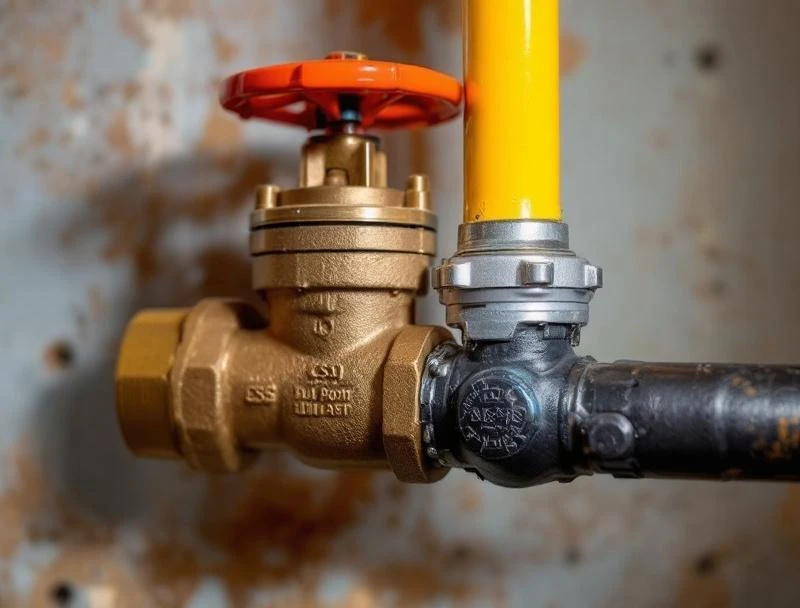
T-handle full-port ball valves are the modern residential standard. Older homes may have multi-turn plug valves that have seized over decades. Replacement requires shutting off upstream, cutting out the old valve, threading in the new ball valve, and pressure testing.
AGA-listed valves are required for natural gas service. Apollo, Watts, and BrassCraft make code-compliant residential ball valves. Valves at appliance connections are typically 1/2-inch or 3/4-inch nominal size.
Common bundled service when a leak detection or appliance-hookup call reveals a seized appliance shutoff that can’t be operated.
Range, Cooktop, and Oven Gas Connection
Range hookup sequence: shut off gas at appliance shutoff, install full-port ball valve if not present, install sediment trap (drip leg) per code, install AGA-rated flex connector with female pipe thread, connect to appliance, pressure test the new connection, leak-check with bubble solution, restore gas, and verify appliance ignition.
Sediment trap is a required code feature — a vertical pipe extension below the appliance shutoff that catches debris before the gas valve. Skipping the sediment trap is a fail-on-inspection issue.
AGA-rated flex connector sizes typically 1/2-inch or 3/4-inch depending on appliance BTU demand. Standard length 4 feet to allow appliance pull-out for cleaning.
Gas Dryer Connection and Conversion
Gas dryer hookup follows the same code framework as range hookup — shutoff valve, sediment trap, AGA-rated flex connector. Standard dryer flex is 4-foot length.
Electric to gas dryer conversion is occasionally requested. The work involves installing a new gas line to the dryer location, capping the unused 240V circuit, and replacing the dryer with a gas model. New gas line installation cost adds significantly to overall project compared to like-for-like gas dryer replacement.
Tankless Water Heater Gas Line Sizing
Tankless water heater conversions are the most common gas-line upsize scope in Tulsa. Navien NPE-A2, Rinnai Sensei, and other 199,000 BTU/hr tankless units demand more gas than original 1/2-inch branches typically deliver.
The sizing calculation uses length-and-diameter pressure drop tables in the Oklahoma Plumbing Code. For typical Tulsa run lengths (20-50 feet from meter to tankless location), 3/4-inch pipe at 7-inch w.c. manifold pressure delivers 199,000 BTU/hr. Original 1/2-inch branches at the same length deliver only 100,000-130,000 BTU/hr.
Conversion scope typically requires running new 3/4-inch line from meter to tankless location. Cost adds $700-$1,800 to the tankless installation total.
Gas valve and thermocouple failures masquerade as gas-line problems, and water heater repair in Tulsa scope covers the appliance-side diagnosis that gas-line work can’t fix.
Whole-House Generator Gas Line
Generac, Kohler RES, and Cummins QuietConnect standby generators sized at 22-26 kW typically demand 200,000-300,000 BTU/hr. Combined with existing house load (water heater, range, furnace), this often exceeds existing meter capacity and forces upsize coordination with ONG.
The work scope: demand-load survey to size the gas line, run new 1-inch black iron or CSST from meter to generator pad with code-compliant sediment trap and shutoff, coordinate ONG meter upsize if needed, pressure test and inspect.
Common in 74133 South Tulsa, 74137 Southern Hills, 74105 Brookside large homes where generator installation is part of broader emergency-preparedness retrofits.
Outdoor Gas Grill, Fire Pit, and Patio Heater
Yard gas extensions to outdoor grills, fire pits, and patio heaters use yellow polyethylene (PE) gas pipe for the buried run with tracer wire. Riser stubs at the appliance location transition to black iron or CSST above grade.
Standard depth-of-cover 18-24 inches per Tulsa code. Anodeless riser at the connection point. Proper bedding sand and backfill compaction. Permit and pressure test required for the new gas line.
Cost varies with run length. 30-50 foot run to a grill or fire pit runs $1,200-$2,800 installed including tracer wire, riser, sediment trap, shutoff, and pressure test.
Yard excavation for a buried gas service line often surfaces aging water service running parallel, and Tulsa water line repair scheduling alongside the same dig saves a second mobilization.
Gas Fireplace and Log Set Connection
Gas fireplace and log set installations require dedicated gas supply with key valve (decorative trim), sediment trap, and shutoff. Millivolt vs electronic ignition changes the connection requirements — millivolt systems use the gas-flame thermopile to generate operating voltage; electronic systems need 120V power supply.
Log lighter (decorative gas log starter) installations on existing wood-burning fireplaces require gas line run to the firebox and a key valve at the hearth. Significant work scope to retrofit gas to a previously wood-only fireplace.
Underground Gas Service Between Meter and House
The buried gas line from meter to house is homeowner responsibility in Oklahoma. ONG owns the meter; everything from the meter forward is the customer’s. This trips up insurance claims and homeowner expectations constantly.
The line is typically yellow PE with tracer wire at 18-24 inch depth. Yard digging strikes are the dominant failure mode. Replacement runs $2,500-$5,500 for typical 60-foot meter-to-house lengths.
Identifying the line before digging is critical. Tracer wire allows location with a metal-detector wand; without tracer wire, locating the line accurately becomes much harder. Always call 811 before any yard excavation.
When a yard excavation reveals a deteriorated water service running parallel to the gas line, burst pipe repair scope picks up the supply-side work in the same trench.
Tulsa-Specific Factors That Shape Gas Line Repair
ONG service area covers all of greater Tulsa. ONG’s headquarters in Tulsa means emergency response in the metro is fast. Oklahoma’s 12-inch frost line means buried gas line minimum depth (18 inches) provides margin for normal freeze events.
CSST adoption split: pre-1995 housing dominantly black iron, post-1995 dominantly CSST. 74137 Southern Hills, 74133 South Tulsa, 74105 Brookside have heavy generator-install demand and tankless conversion driving gas line upsize. 74012 Broken Arrow, 74008 Bixby, 74055 Owasso, 74037 Jenks post-1990 CSST is dominant; lightning bonding is the recurring concern.
74103 Downtown / Tulsa Arts District, 74104 Cherry Street, 74114 Maple Ridge — pre-1950 black iron systems with original threaded joints, settlement-driven leaks. 74135 Patrick Henry, 74129 East Tulsa, 74145 Eastland — 1960-90 mixed black iron and early CSST; appliance shutoff failures common.
Oklahoma Plumbing Context for Gas Line Work
Oklahoma Plumbing License Law Title 59 § 1001 reserves natural gas work to licensed plumbers. Oklahoma Construction Industries Board (CIB) licenses plumbing contractors for gas-fitting work. Verify any contractor’s license at cib.ok.gov before authorizing any gas work.
Tulsa Fire Marshal has jurisdiction over gas appliance venting clearances and emergency response. Tulsa Codes & Construction Services issues permits for gas line work and coordinates AHJ inspections. Oklahoma Natural Gas (ONG) as a ONE Gas subsidiary handles utility-side response and meter upsize coordination.
CSST bonding requirement (post-amendment) is enforced on all new installs. Older installs are grandfathered but unsafe — recommended bonding upgrade on any service call where existing CSST lacks bonding.
Gas leaks fall outside normal business hours by definition, and our Emergency Plumber Tulsa dispatch handles odor-of-gas calls and meter-side coordination at any hour.