A sewer line repair Tulsa call is the highest ticket-value plumbing scope outside of whole-home repipe, and the most consequential. The lateral connecting your home to the city mainline runs under the yard, often under driveway or hardscape, and failures cascade quickly from intermittent backups to sewage on living-area floors. This page covers camera inspection, hydrojetting, trenchless options (CIPP and pipe bursting), open-trench replacement, and the full diagnostic-through-repair workflow our Tulsa network handles.
The dominant failure mode in Tulsa is tree root invasion in pre-1960 clay-tile and cast-iron laterals. Maple Ridge (74114), Cherry Street (74104), Brookside (74105), Owen Park (74127) all have predictable root patterns from mature street trees. Bell-and-spigot clay tile with cement mortar joints is essentially universally failed at 80+ years. Cast iron in 1940s-60s post-war housing shows offset joints from settlement and 30-50% bore reduction from scale.
What a Sewer Line Repair Costs in Tulsa Right Now
Camera inspection runs $250-$450 — diagnostic deliverable that often stands alone before any repair commitment. Mechanical snake with root cutter $350-$650. Hydrojetting residential $450-$900, commercial $4,000-$7,000-class jetting at higher pressure for restaurant grease lines.
For repair scope: spot repair (single defect, open trench, 4-6 ft depth) $1,800-$3,500. Trenchless pipe lining (CIPP, typical 50-80 ft lateral) $5,000-$10,500. Pipe bursting (50-80 ft) $4,500-$9,000. Full open-trench replacement $5,500-$12,500 plus landscape restoration. Cleanout installation $650-$1,500. Sewer ejector pump replacement $1,800-$3,500. Backflow assembly (RPZ) installation $850-$1,800.
The choice between trenchless and open-trench depends on lateral condition, number of bends, surface conditions above the lateral, and homeowner preference for landscape preservation. We provide written estimates for both options when both are technically feasible.
Backup, Smell, and Yard Symptoms That Mean the Lateral Is Failing
Sewage backing up onto floors is the catastrophic-end symptom — by the time this happens, the lateral has been progressively failing for months or years. Earlier warning signs include recurring slow drainage that worsens over months, gurgling sounds in adjacent fixtures during drain events, sewer-gas odor from floor drains or unused fixtures, and visible vegetation patterns (greener grass) above the lateral path.
Yard symptoms include lawn settlement above the lateral (creating a depression), vegetation patterns indicating concentrated moisture, soft spots in turf, and odor at lawn surface. For homes with trees within 30 feet of the lateral path, root-invasion symptoms typically begin between year 8-15 of tree root maturity and accelerate from there.
For older laterals (clay tile, cast iron pre-1960), the recurring-backup pattern combined with root invasion eventually triggers the trenchless-or-replace decision. Camera inspection definitively documents the condition and structures the repair scope.
How Camera Inspection and Hydrojetting Work Together to Diagnose
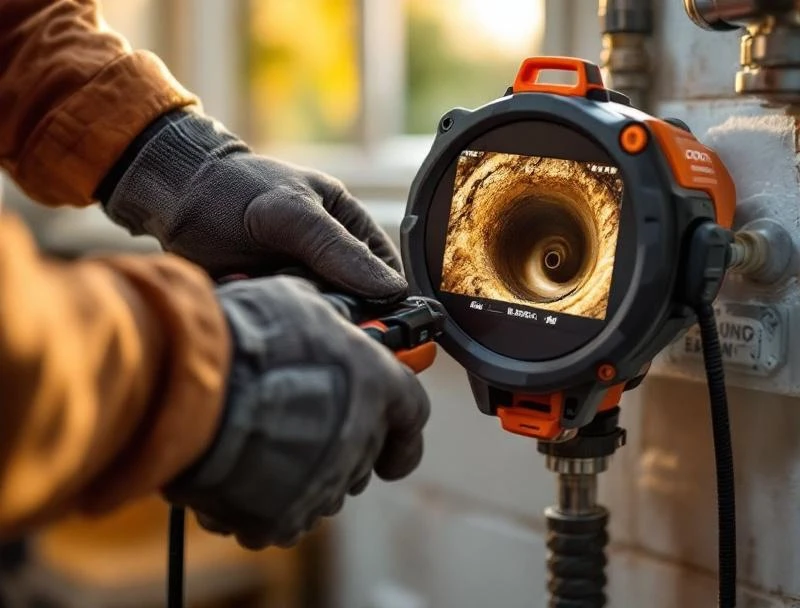
The standard diagnostic sequence: camera inspection from the cleanout, locate any defects with sonde transmitter and NaviTrack wand, document with recorded video, then make a repair recommendation based on findings. RIDGID SeeSnake CS6, CS65, and CS12X camera systems handle different lateral sizes and access points.
If the camera reveals roots without structural defects, hydrojetting with a rotating warthog or root-cutting nozzle clears the obstruction and RootX foaming herbicide treatment immediately after extends service interval by 1-2 years. If the camera reveals offset joints, cracks, missing bottom-of-pipe, or collapsed sections, the diagnostic shifts to repair-scope estimation.
The camera also documents the line’s condition for insurance and for future reference. Real estate transactions, insurance claims, and pre-purchase inspections all benefit from recorded video deliverable.
Trenchless vs Open-Trench Repair on a Tulsa Property
Trenchless pipe lining (CIPP) uses a felt liner saturated with two-part epoxy resin, inverted into the existing pipe and cured. The resulting cured-in-place pipe is essentially a new pipe inside the old one — 50-year manufacturer service life, no excavation required. Best for laterals with minor defects (cracks, hairline offsets, root entry points) where the host pipe is structurally sound enough to support the cure.
Pipe bursting uses a pneumatic head that splits the existing pipe outward while pulling new HDPE replacement pipe behind it. Best for clay-tile or cast-iron laterals that need full structural replacement but where excavation is impractical (mature landscape, driveway crossing, hardscape).
Open-trench replacement uses traditional excavation to access the lateral, remove it, and install new SDR-26 PVC. Best for laterals with multiple bends that prevent trenchless tooling, for laterals with severe collapse that doesn’t support pipe bursting, or for situations where surface restoration cost is low.
Each method has a fit. We assess all three on every replacement quote and recommend the best technical and economic choice.
Why Maple Ridge and Cherry Street Lateral Failures Are So Predictable
Pre-1930 Tulsa neighborhoods have predictable lateral failure patterns. Clay-tile pipe with bell-and-spigot joints sealed with cement mortar was the standard from 1900 to roughly 1950. The joint mortar shrinks and cracks over decades, creating moisture-permeable seams that tree roots find. Once roots establish, they expand the joint and accelerate decay.
Cast iron replaced clay in roughly 1940-1980 construction. Internal scale builds at 1-2% bore reduction per decade; by year 50, a 4” cast iron line has 30-50% effective bore reduction from scale alone. Joint failures and longitudinal cracks add to the structural decay.
The mature street-tree canopy in Maple Ridge and Cherry Street — silver maples, post oaks, American elms — sends roots aggressively toward damp soil. The combination of failing joints (clay or cast iron) plus aggressive tree species produces some of the highest sewer-failure rates we encounter in the Tulsa metro.
Property-Line Responsibility and the City of Tulsa Sewer Connection
The City of Tulsa property-line demarcation transfers responsibility from city mainline to homeowner lateral at the right-of-way edge. This affects who pays for which repair scope and is a frequent point of confusion. City of Tulsa Wastewater maintains the mainline; the homeowner maintains the lateral from the property line forward.
Some configurations place the demarcation at the cleanout rather than the right-of-way. Tulsa Codes & Construction Services issues permits for sewer-side work that crosses or modifies the demarcation. Northside Wastewater Treatment Plant and Southside Wastewater Treatment Plant define service territory within Tulsa city limits; suburban authorities have separate connection rules.
Tulsa’s typical lateral depth ranges from 4 ft in newer suburbs (74012 Broken Arrow, 74008 Bixby) to 6+ ft in older Maple Ridge 74114 and Cherry Street 74104 properties. Depth governs whether OSHA shoring is required (4+ ft requires shoring) and shifts cost.
When Snaking Is Enough and When the Line Has to Come Out
Snaking is the right answer for occasional debris obstructions, single-event blockages, and as initial intervention before camera diagnosis. Snaking buys time on a degrading lateral but doesn’t fix structural problems. If snaking restores flow, the homeowner has time to plan repair work without crisis pressure.
Snaking is the wrong answer for: collapsed pipe (the cable can’t navigate around the collapse), severe root mass (mechanical clearing won’t keep up with regrowth), polybutylene drain laterals (brittle behavior under aggressive cabling), or extensive scale/rust restriction in cast iron (the bore is too narrow for effective cabling).
The decision marker: if the same line is back-flowing within 30-60 days of a successful clear, the line itself is the problem. Camera inspection and repair scope replace continued reactive cleaning.
Why Backup Means Stop Using Water Now
Sewage backing up onto floors is a stop-immediately situation. Continued water use will worsen the backup, drive sewage further into the home, and increase contamination scope. Shut off water at the main and call us. We coach stabilisation while a truck rolls.
For partial backups (slow drainage with no overflow), reducing water use until we arrive prevents escalation. Run only essential fixtures. Don’t use the washing machine or dishwasher. Avoid showers if a single bathroom is the only access.
Sewage contamination is a health hazard. Once backup occurs, the affected area requires professional remediation — restoration contractors handle the cleanup, dehumidification, and any drywall/flooring replacement. We document the failure for insurance submission.
Sewer Camera Line Inspection
Camera inspection is the foundation of every modern sewer-line decision. RIDGID SeeSnake systems with color CMOS camera heads and pushrod cable navigate residential laterals from accessible cleanout. The NaviTrack II locator detects the sonde transmitter at the camera tip, allowing precise marking of any defect on the surface above.
Standard residential camera inspection takes 45-90 minutes including setup, push, location, and recording. The deliverable is recorded video showing the line interior, identification of any defects (roots, offsets, cracks, bellies), depth and distance markers, and surface marking of significant defect locations.
Real-estate sewer scope inspections are formatted with standardized defect categorization (root, belly, crack, offset, scale) for closing-table use. Insurance documentation packages add date-stamped images and defect descriptions for claim submission.
Sonde-and-camera location is the standard, and Tulsa leak detection adds smoke testing and tracer-gas verification when the camera signal is ambiguous about the exact break point.
Hydrojetting for Roots, Grease, and Scale
Hydrojetting at 1500-4000 psi residential cuts roots and flushes grease and scale. The rotating jet head simultaneously drives the cable forward and scrubs the pipe walls. Restaurant-grade applications use 4000-7000 psi commercial rigs.
US Jetting, Harben, and Sewer Equipment Company rigs handle the full pressure range. Nozzle selection: rotating warthog for grease, fixed nozzle for general flush, root-cutting nozzle for invasion. RootX or FloraTox foaming herbicide treatment after jetting extends root-clearing service intervals.
Limitations: hydrojetting at full pressure can damage compromised cast iron, polybutylene drain laterals, and severely scaled clay tile. Camera inspection first, then jetting at appropriate pressure for the pipe condition, is the standard professional sequence.
Cabling and hydro-jetting are the first-line response to a slow main, and drain cleaning Tulsa OK scope covers the diagnostic that confirms whether replacement is actually needed before any pit gets dug.
Trenchless Pipe Lining (CIPP)
Cured-in-place pipe (CIPP) installation uses a felt liner saturated with two-part epoxy resin. The liner is inverted into the host pipe via drum or steam pressure, calibrated to fit the pipe interior, and cured for 1-4 hours depending on resin chemistry. The result is a structural pipe-within-a-pipe with 50-year manufacturer service life.
Perma-Liner and Nu Flow are dominant CIPP systems in Tulsa. Installation requires access at one end (typically the cleanout) and a termination point at the mainline tap. Bends greater than 45 degrees complicate liner installation; significant size changes require alternative methods.
Best applications: clay-tile or cast-iron laterals with minor defects, mature streetscape where excavation is impractical, driveway and landscape preservation priorities. Cost is competitive with open-trench once surface restoration is included.
Pipe Bursting for Failed Clay and Cast Iron
Pipe bursting splits the existing pipe outward while pulling new HDPE replacement pipe behind it. TT Technologies Grundocrack and HammerHead are the dominant pneumatic bursting systems. Two small entry pits — one at each end of the lateral — provide access; everything between is bursted underground.
The bursting head shatters clay tile and breaks cast iron cleanly. PVC and HDPE replacement pipe pulls in behind. Standard residential bursting handles 4-inch clay or cast iron replacement with 4-inch HDPE pull-pipe.
Best applications: failed clay-tile laterals where CIPP isn’t appropriate (collapsed sections, missing bottom of pipe), cast-iron with severe scale that warrants full replacement, full lateral capacity restoration. Limitations: bends greater than 22.5 degrees can’t be bursted, and significant size upsize requires open-trench transitions.
Sewer Lateral Replacement (Open Trench)
Traditional open-trench excavation removes the existing lateral and installs new 4” SDR-26 PVC (residential standard) or 6” SDR-26 PVC (commercial or restaurant residential). Mainline tap (saddle, wye, or chimney) installation, bedding sand placement, code-compliant slope (1/4” per foot residential), and compacted backfill in lifts.
OSHA shoring required at 4+ ft depth — typical Tulsa lateral depth is 4-6 ft, so most jobs require shoring boxes. Tulsa Codes & Construction Services issues the excavation permit and inspects the work. Surface restoration (sod replacement, hardscape repair) is typically separate from the lateral work itself but coordinated with the dig.
Best applications: severe lateral failure with multiple bends, lateral upsizing, mainline tap relocation, situations where surface restoration cost is low (rural/suburban yards without mature landscape).
Yard excavation for sewer replacement often surfaces a deteriorating water service running parallel, and yard service line work in the same trench eliminates a future second dig that costs more than the upfront combination.
Tree Root Removal and RootX Treatment
Mechanical root cutting with appropriate cutter heads on a heavy-duty drum machine clears the immediate root mass. 3-inch and 4-inch cutter heads for residential laterals, with cable lengths of 75-100 feet for most Tulsa applications.
RootX foaming herbicide treatment applied immediately after mechanical clearing extends service interval by 1-2 years. The herbicide kills root tips at the entry point without damaging the parent tree (root pruning effect rather than tree kill). FloraTox is the alternative product with similar efficacy.
For chronic root invasion that recurs annually, the long-term fix is structural repair (CIPP, pipe bursting, or open-trench replacement) of the entry-point joint failure. Continuing to mechanically clear without addressing the entry point is a never-ending maintenance scope.
Sewer Scope Real Estate Inspection
Pre-purchase sewer scope inspections use standardized format for real-estate transaction use. The deliverable includes recorded video of the lateral interior, defect categorization (root, belly, crack, offset, scale), severity grading, and approximate repair-cost estimate.
Tulsa real-estate transactions have grown the sewer-scope segment significantly — particularly in pre-1960 neighborhoods where sewer-line condition is the largest unknown variable in the sale. 74105 Brookside, 74104 Cherry Street, 74114 Maple Ridge, 74127 Owen Park all see frequent pre-purchase scopes.
Standard format: 8-12 page report with timestamps, depth markers, defect images, and cost estimate. Buyer’s agents and home inspectors increasingly request the scope as a routine inspection step.
Backflow Prevention (RPZ Valves)
Backflow prevention assemblies prevent contaminated water from flowing backward into the potable system. Required by City of Tulsa Cross-Connection program for any property with irrigation, fire suppression, boiler, or process-water connections.
Watts 909, Febco 825Y, Wilkins 975XL are the dominant residential and small-commercial RPZ assemblies. Annual testing required by City of Tulsa; certified tester registration through the cross-connection program.
Installation requires shutting off the relevant supply, cutting in the assembly with appropriate fittings, ensuring the assembly is accessible for annual testing, and submitting completion documentation to the City of Tulsa Cross-Connection program.
Sewer Cleanout Installation
Pre-1960 Tulsa homes commonly lack accessible cleanouts at the property line. Installing a two-way cleanout as part of repair work allows future cabling toward the house or toward the street, simplifying every subsequent maintenance call.
Cherne and Oatey cleanout fittings dominate Tulsa standard practice. Two-way (Y-pattern) cleanouts allow both direction access. Riser pipes bring the cleanout to grade with a brass cleanout cap. Code-required placements include at the property line, at the house exit point, and at any branch junction in the lateral.
Main Sewer Line Locating
The NaviTrack II locator detects sonde transmitter signals at the camera tip, providing surface marking accuracy of ±5% of depth. Sonde frequencies (33 kHz / 512 Hz / 8 kHz) match camera systems and surface conditions. Required step before any excavation to avoid digging in the wrong location.
Tracer-wire location works for newer plastic laterals with installed tracer wire. Older clay or cast iron laterals are typically located via sonde/camera combination since they’re not metal-detectable directly.
Sewer Ejector Pumps for Below-Grade Fixtures
Below-grade bathrooms and laundries (below the main sanitary stack height) require sewer ejector pumps to lift waste up to the main drain. Liberty LE71, Zoeller 267, Saniflo SaniBest grinder pumps handle different applications. Basin sizing 30-100 gallon depending on fixture count and runtime requirements.
Distinct from sump pumps (which handle storm/groundwater) — ejector pumps handle sewage and require sealed basins, vented per code, with appropriate check valves. Common in pre-1960 Tulsa basements where finished basement bathrooms were retrofitted into existing space below grade.
Below-grade bathrooms and laundries rely on sewer ejector pump repair scope rather than gravity drainage, and the ejector basin and pump are a distinct failure mode from sump pumps even though the install looks similar.
Polybutylene Sewer Pipe Identification
Polybutylene drain laterals were installed in some 1978-1995 Tulsa subdivisions — typically misidentified by inexperienced contractors as PVC, but require different repair handling due to brittle behavior. Identify by gray colour and acetal-plastic fittings; PVC is white or beige with solvent-welded fittings.
PB drain failures are typically catastrophic at fittings rather than progressive at pipe walls. Heavy mechanical cabling can crack PB unexpectedly. Camera inspection first, then careful intervention sequencing, is the standard approach.
Tulsa-Specific Factors That Shape Sewer Line Repair
Pre-1930 neighborhoods (74104, 74114, 74120, 74127) have clay-tile laterals essentially universally failed at joint level. Cast iron in 1940s-60s 74105 Brookside and 74112 Highland Park shows 30-50% bore reduction from scale plus offset joints from settlement. Modern PVC in 74012 Broken Arrow and 74008 Bixby rarely needs major repair.
Mature street trees — silver maples, post oaks, sweetgum — drive Tulsa’s high root-invasion rate. 74104 Cherry Street and 74114 Maple Ridge see chronic root issues; 74105 Brookside moderate; newer subdivisions minimal.
Polybutylene era 1978-1995 affects parts of 74135 Patrick Henry, 74129 Sequoyah, 74145 Kensington. These laterals require different inspection and intervention compared to clay or PVC.
Oklahoma Plumbing Context for Sewer Line Work
Sewer-line repair scope falls under Oklahoma CIB licensing for the structural repair work, the mainline tap installation, and the trenchless or open-trench replacement. Verify any contractor’s license at cib.ok.gov before authorizing work.
Tulsa Codes & Construction Services issues excavation permits. City of Tulsa Wastewater coordinates mainline-tap work. Tulsa County Health Department handles septic-related coordination on properties outside city sewer service (some rural and edge properties — Coweta, Skiatook).
Backflow assembly installation falls under the City of Tulsa Cross-Connection program with certified tester requirements. Annual testing is mandatory and assembly status affects utility service.
When raw waste comes back up the floor drain at midnight, our Emergency Plumber Tulsa dispatch is the same call that handles sewer cameras and trenchless lining once the immediate backup is cleared.